By Raju Lama
International President, SAARC Journalist Forum
New York, United States — The 3rd International Indigenous Language Journalism Conference 2026 is set to bring together journalists, editors, media professionals, researchers, Indigenous leaders and policymakers from around the world in Kathmandu from August 9 to 12.
The conference, being organized by the Federation of Nepalese Indigenous Nationalities Journalists (FoNIJ) in coordination with the Newa National Forum of Journalists and SAARC Journalist Forum, comes at an important moment for Indigenous communities and minority-language media. Organizers expect participation from journalists representing approximately 40 countries.
The central theme—“Indigenous Language Journalism for Cultural Diversity, Climate Justice and Inclusive Democracy”—highlights the growing recognition that journalism in Indigenous and minority languages is not simply a cultural activity. It is an essential component of democratic participation, social inclusion, cultural preservation and access to information.
Journalism as a Voice for Indigenous Communities
For generations, Indigenous communities around the world have faced challenges in getting their stories, concerns and aspirations represented accurately in mainstream media.
Indigenous-language journalism can help address this gap by allowing communities to tell their own stories in their own languages. It can preserve traditional knowledge, document cultural practices and provide information about issues such as land rights, climate change, education, migration, development and human rights.
The need for more inclusive journalism is particularly important in an era of rapid digital transformation. Social media and digital platforms have created new opportunities for Indigenous journalists, but they have also introduced challenges involving misinformation, language inequality, digital exclusion and the loss of traditional forms of communication.
Research on Indigenous media representation has also pointed to concerns about under-representation and negative framing of Indigenous issues, reinforcing the importance of strengthening Indigenous-led journalism and newsroom capacity.
The South Asian Dimension
South Asia is home to extraordinary linguistic, cultural and Indigenous diversity. From Nepal’s mountains and hills to India’s Northeast and central regions, Bangladesh’s Indigenous communities, Sri Lanka and other parts of the region, journalism can play a critical role in documenting communities whose voices have historically received limited attention.
In this context, the SAARC Journalist Forum has an important regional responsibility. SJF’s stated mission includes organizing journalists across South Asia to promote press and expression freedom and protect the rights and dignity of journalists. Its objectives also include bringing journalists together across the SAARC region and promoting professional excellence.
The Indigenous Language Journalism Conference provides an opportunity to extend that mission into the field of Indigenous and minority-language journalism.
The Role of SAARC Journalist Forum
The participation of SJF should not be viewed simply as institutional cooperation. It represents an opportunity to build a stronger regional network of journalists committed to inclusive journalism.
1. Connecting Indigenous Journalists Across South Asia
SJF can help establish stronger professional links among Indigenous journalists from Nepal, India, Bangladesh, Bhutan, Sri Lanka, Pakistan and other parts of South Asia.
A regional network could facilitate exchange of reporting techniques, investigative methods, digital skills and experiences in covering Indigenous communities.
2. Promoting Language Diversity in Journalism
Language is fundamental to identity. SJF can advocate for greater recognition of journalism in Indigenous and minority languages and encourage mainstream media organizations to provide space for multilingual reporting.
The objective should not be to replace mainstream journalism but to create a more inclusive media ecosystem in which Indigenous-language journalism and national and international media complement each other.
3. Strengthening Press Freedom
Indigenous journalists frequently operate at the intersection of journalism, community rights and social conflict. They may face pressure, discrimination, limited resources or restricted access to information.
SJF can provide a regional platform for discussing journalist safety, press freedom and professional standards while ensuring that Indigenous journalists are not marginalized within the broader journalism community.
4. Climate Justice and Indigenous Knowledge
Climate change is one of the defining challenges facing Indigenous communities.
Indigenous peoples often possess generations of knowledge about forests, water, agriculture, biodiversity and environmental stewardship. Journalism can help bring this knowledge into national and international climate conversations while maintaining accuracy, consent and respect for community ownership.
The conference’s focus on climate justice therefore creates an important bridge between Indigenous journalism and global environmental reporting.
5. Building Cross-Border Media Cooperation
South Asian Indigenous communities often face issues that transcend national borders, including climate change, migration, environmental degradation and cultural preservation.
SJF can encourage cross-border reporting projects that allow journalists to investigate these issues collaboratively rather than viewing them solely through national perspectives.
Digital Media: A New Opportunity
Digital journalism offers Indigenous-language media an unprecedented opportunity. A small newsroom can now publish news, podcasts, video reports and social-media content to audiences around the world. Artificial intelligence, translation technologies and digital archives may also help preserve endangered languages and expand access to information.
But technology must serve communities rather than erase linguistic diversity. AI-generated translation, for example, can be useful but should not replace Indigenous journalists and community knowledge. Human editorial judgment, cultural context and linguistic expertise remain essential.
From Conference to Action
The most important question is what happens after the conference. Kathmandu should become more than a meeting place. It can become the starting point for a long-term international network of Indigenous-language journalists.
The conference could contribute to practical initiatives such as:
* An international network of Indigenous-language journalists;
* Regional training programs in digital and investigative journalism;
* Fellowships for Indigenous journalists;
* Cross-border investigative reporting projects;
* Digital archives for Indigenous-language journalism;
* Journalist-safety mechanisms;
* Partnerships between Indigenous and mainstream media;
* Programs supporting women and young Indigenous journalists;
* Training on climate, human rights and conflict-sensitive reporting; and
* Greater representation of Indigenous voices in international media.
A New Media Partnership for the Global South
The Indigenous Language Journalism Conference also offers a broader lesson for journalism in the Global South. Media diversity should not be measured only by the number of news organizations or digital platforms. It should also be measured by whose voices are heard, whose languages are represented and whose stories are allowed to shape public debate.
The SAARC region can demonstrate that regional journalism organizations have a responsibility to defend not only the freedom of journalists but also the diversity of the communities they serve. For SJF, participation in this international conference can therefore become part of a wider commitment to press freedom, cultural diversity, peace journalism and inclusive democratic communication.
Conclusion
The 3rd International Indigenous Language Journalism Conference comes at a critical time for journalism. As the world becomes increasingly interconnected, linguistic and cultural diversity must not disappear from the media landscape. Indigenous journalists are not merely reporters of their communities; they are important custodians of language, culture, history and public memory. Kathmandu can provide an important platform for these voices to connect with the wider world.
For the SAARC Journalist Forum, the challenge is clear: to transform regional solidarity into practical cooperation, strengthen Indigenous and minority-language journalism, protect journalists’ rights and ensure that every community has the opportunity to participate in the democratic information system. A free press must be diverse. A democratic media must be inclusive. And journalism cannot truly serve humanity unless every language and every community has the right to be heard.


Posted: August 14, 2026 by admin_raju Leave a Comment
SJF Delegation pay courtesy call with SAARC Secretary General Md Golam Sarwar
Kathmandu, August 14 – SAARC journalists from Bangladesh today made a courtesy call on SAARC Secretary General Ambassador Golam Sarwar at his office in Kathmandu, Nepal.
A delegation of journalists from Bangladesh representing the SAARC Journalist Forum paid a courtesy call on the Secretary General of the South Asian Association for Regional Cooperation (SAARC), Ambassador Md. Golam Sarwar, at the SAARC Secretariat in Kathmandu.
During the meeting, the delegation discussed issues relatining to regional media collaboration, press freedom, and the role of journalists in fostering peace, economic growth, and cultural exchange among the South Asian countries.
The delegates stressed the need for practicing responsible journalism to bridge gap among the nations and highlighted the urgency to meet the challenges like climate change, trade and business to foster socio-economic development.
The SAARC Secretary expressed his sincere efforts to support any initiatives aimed at promoting peace, prosperity and developing journalism for the welfare of the people of the region.
He also emphasized on cross-border professional dialogue, and institutional collaboration among journalists of member states.
The delegation included Md Abdur Rahman Secretary General SAARC Journalist Forum and Senior Correspondent of The Bangladesh post along with Mustaq Ahmed Mubaraqui, Editor:The Daily Bangabani, Md Ziaur Rahman, Special Correspondent The Daily Ajkal, Mohammad Moniruzzaman, Editor: Daily Bank Bima Arthority, Md. Abu Bakar Siddique, Senior Correspondent, Daily Ajker Probhat.
Posted: August 13, 2026 by admin_raju Leave a Comment
Journalist delegates visit Bangladesh Embassy in Kathmandu
Special Correspondent, Kathmandu: A joint delegation of senior journalists from Bangladesh and Nepal visited Bangladesh embassy on Thursday. The delegates, who attended the recently concluded ‘3rd International Indigenous Language Conference-2026’, visited the Bangladesh House in Kathmandu today.
Embassador Shafiqur Rahman received the 10- member delegation and exchanged views on vavries issues regarding Nepal-Bangladesh relations as well as the recently concluded conference on indeginous language journalism and the role of Bangladesh in this regard.
A 13 member delegation is now in Kathmandu in connection with the 4-day indigenous language conference. The conference was held from August 9-12 in Kathmandu in connection with observance of the World Indigenous Day on August 9. About 35,000 people attended the World Indigenous Day including delegations from 17 countries.
Led by Ziaur Rahman the Bangladesh delegation includes MD Abdur Rahman, Secretary General of SAARC Journalist Forum and Senior Correspondent of The Bangladesh Post; Mustaq Ahmed Mubaraqui, Editor of The Daily Bangabani; MD Ziaur Rahman, Special Correspondent of The Daily Ajkal; Mohammad Moniruzzaman, Editor of Daily Bank Bima Arthority; Panna Zaman, Managing Editor of Daily Amar Bangla; and MD Abu Bakar Siddique, Senior Correspondent of Daily Ajker Probhat.
The Nepali representatives, who accompanied the Bangladesh delegation at the embassy, included Nripendra Lal Shrestha, President of the National Forum of Newar Journalists and Editor of Lahana Media; Sunil Maharjan, Vice President of the National Forum of News Journalists; Surendra Bhakta Shrestha from Lahana Weekly; and Raju Napit from AP1 TV.
The meeting was followed by a lunch hosted in honor of the delegation. The entire event took place in a warm and cordial atmosphere.
Last Updated: August 13, 2026 by admin_raju Leave a Comment
SAARC Journalist Forum Condemns Arrest of Senior Nepali Journalist Kishor Shrestha
Kathmandu, Nepal | August 13, 2026 – The SAARC Journalist Forum (SJF) has strongly condemned the arrest of senior Nepali journalist and Chief Editor of Jana Aastha Weekly, Kishor Shrestha, calling for his immediate and unconditional release.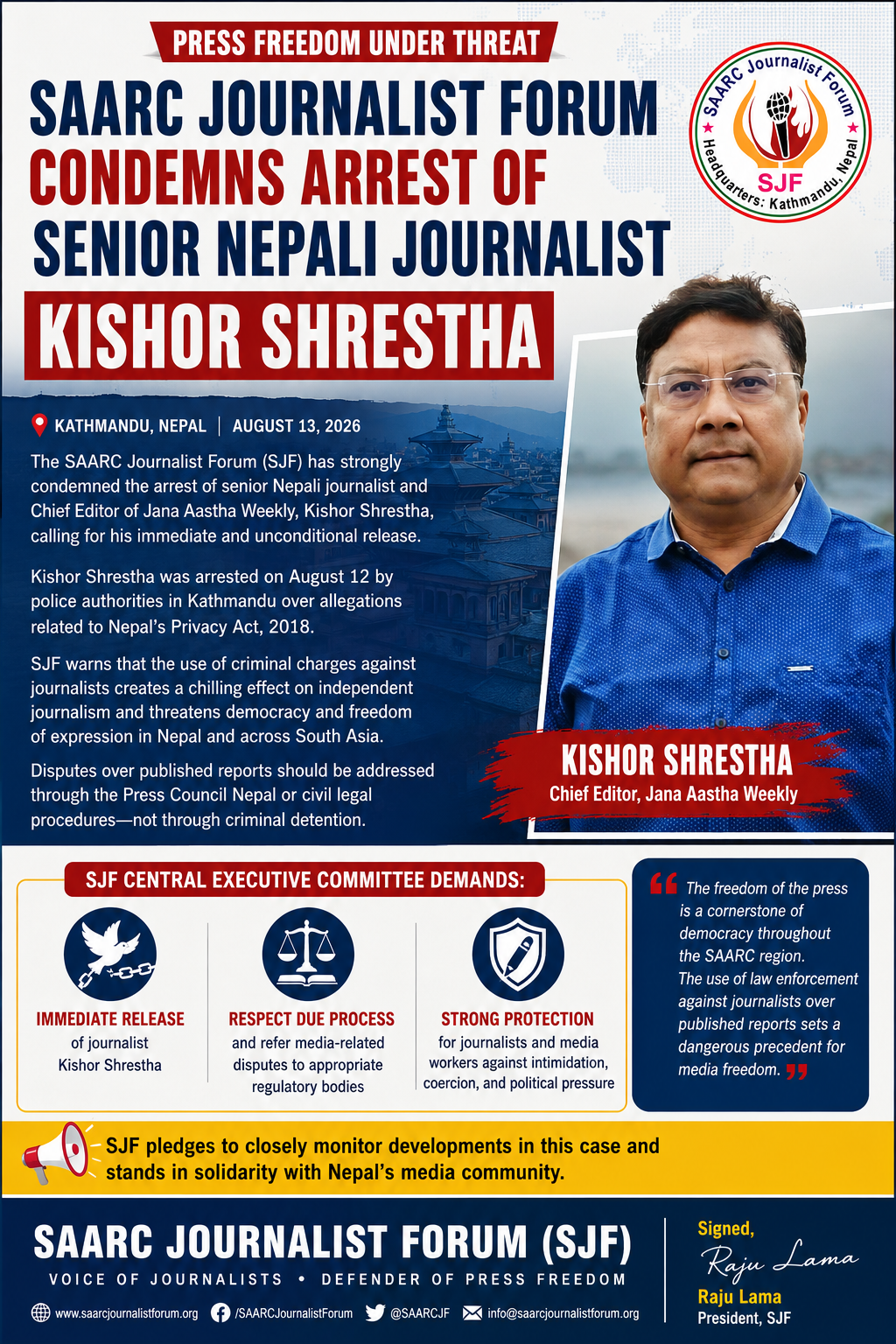 In a press statement issued on August 13, SJF expressed deep concern over the detention of Shrestha by police authorities in Kathmandu. According to reports, officers from the Kathmandu District Police Range and the Kathmandu Valley Crime Investigation Office arrested the veteran journalist on August 12 over allegations related to Nepal’s Privacy Act, 2018.
The regional media organization described the arrest as a serious threat to press freedom, democratic values, and freedom of expression in Nepal and across South Asia. SJF argued that disputes arising from published news reports should be addressed through established media oversight mechanisms, including the Press Council Nepal, or through civil legal procedures rather than criminal detention.
In its statement, the Forum warned that the use of criminal charges against journalists could create a chilling effect on independent journalism and discourage investigative reporting on matters of public interest. The organization emphasized that Nepal’s Constitution guarantees freedom of expression and press freedom, rights that should be respected by all state institutions.
“The freedom of the press is a cornerstone of democracy throughout the SAARC region,” the statement noted, adding that the use of law enforcement mechanisms against journalists over published reports sets a dangerous precedent for media freedom.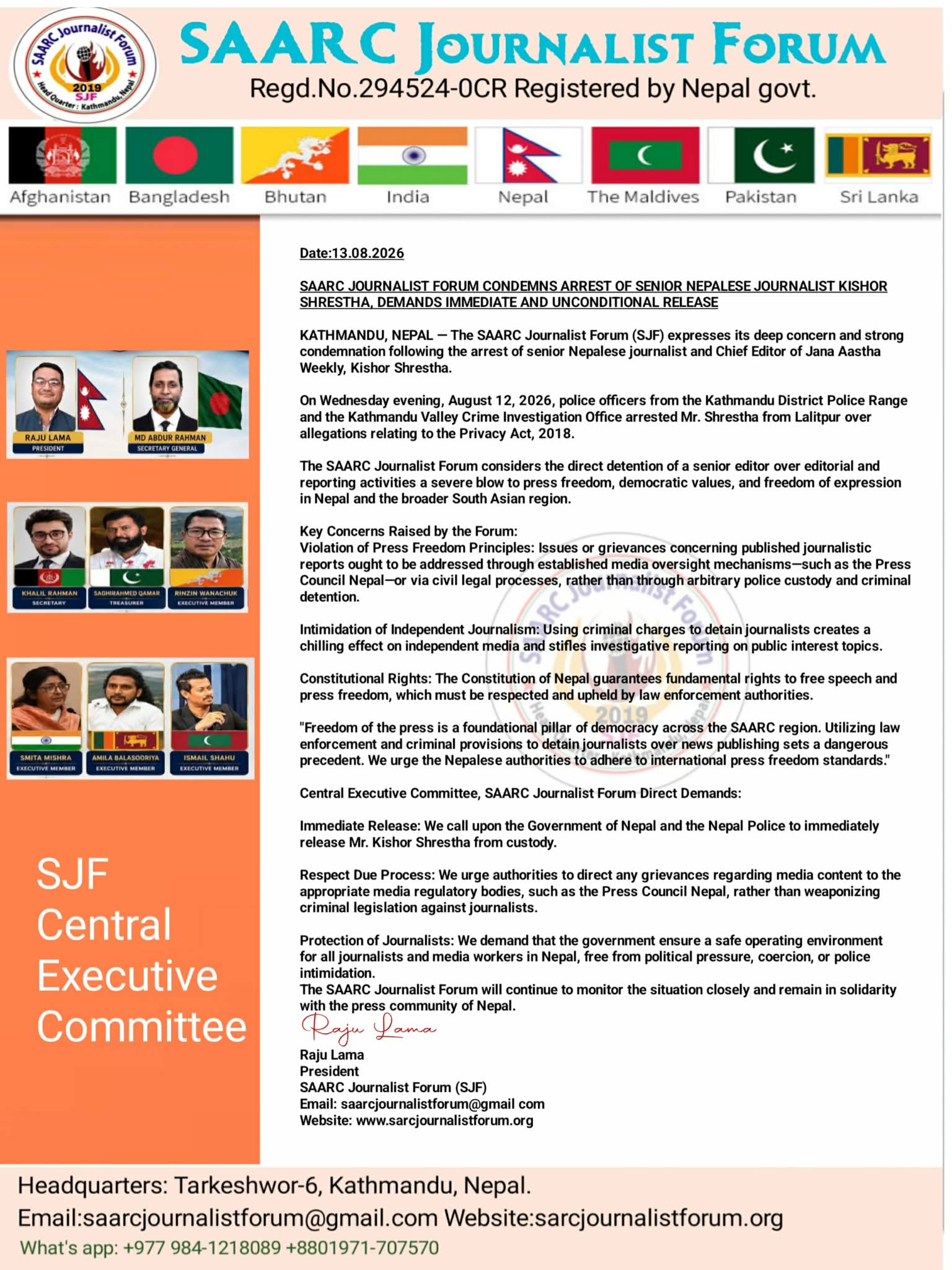 The SJF Central Executive Committee issued three key demands:
• Immediate release of journalist Kishor Shrestha.
• Respect for due process and referral of media-related disputes to appropriate regulatory bodies.
• Stronger protection for journalists and media workers against intimidation, coercion, and political pressure.
The Forum also pledged to closely monitor developments in the case and expressed solidarity with Nepal’s media community.
SJF President Raju Lama signed the statement on behalf of the organization and reiterated the Forum’s commitment to defending media freedom and protecting journalists throughout the South Asian region.
Posted: August 9, 2026 by admin_raju Leave a Comment
3rd International Indigenous Language Journalism Conference: Strengthening Indigenous Voices and the Role of SAARC Journalist Forum
By Raju Lama
International President, SAARC Journalist Forum
New York, United States — The 3rd International Indigenous Language Journalism Conference 2026 is set to bring together journalists, editors, media professionals, researchers, Indigenous leaders and policymakers from around the world in Kathmandu from August 9 to 12.
The conference, being organized by the Federation of Nepalese Indigenous Nationalities Journalists (FoNIJ) in coordination with the Newa National Forum of Journalists and SAARC Journalist Forum, comes at an important moment for Indigenous communities and minority-language media. Organizers expect participation from journalists representing approximately 40 countries.
The central theme—“Indigenous Language Journalism for Cultural Diversity, Climate Justice and Inclusive Democracy”—highlights the growing recognition that journalism in Indigenous and minority languages is not simply a cultural activity. It is an essential component of democratic participation, social inclusion, cultural preservation and access to information.
Journalism as a Voice for Indigenous Communities
For generations, Indigenous communities around the world have faced challenges in getting their stories, concerns and aspirations represented accurately in mainstream media.
Indigenous-language journalism can help address this gap by allowing communities to tell their own stories in their own languages. It can preserve traditional knowledge, document cultural practices and provide information about issues such as land rights, climate change, education, migration, development and human rights.
The need for more inclusive journalism is particularly important in an era of rapid digital transformation. Social media and digital platforms have created new opportunities for Indigenous journalists, but they have also introduced challenges involving misinformation, language inequality, digital exclusion and the loss of traditional forms of communication.
Research on Indigenous media representation has also pointed to concerns about under-representation and negative framing of Indigenous issues, reinforcing the importance of strengthening Indigenous-led journalism and newsroom capacity.
The South Asian Dimension
South Asia is home to extraordinary linguistic, cultural and Indigenous diversity. From Nepal’s mountains and hills to India’s Northeast and central regions, Bangladesh’s Indigenous communities, Sri Lanka and other parts of the region, journalism can play a critical role in documenting communities whose voices have historically received limited attention.
In this context, the SAARC Journalist Forum has an important regional responsibility. SJF’s stated mission includes organizing journalists across South Asia to promote press and expression freedom and protect the rights and dignity of journalists. Its objectives also include bringing journalists together across the SAARC region and promoting professional excellence.
The Indigenous Language Journalism Conference provides an opportunity to extend that mission into the field of Indigenous and minority-language journalism.
The Role of SAARC Journalist Forum
The participation of SJF should not be viewed simply as institutional cooperation. It represents an opportunity to build a stronger regional network of journalists committed to inclusive journalism.
1. Connecting Indigenous Journalists Across South Asia
SJF can help establish stronger professional links among Indigenous journalists from Nepal, India, Bangladesh, Bhutan, Sri Lanka, Pakistan and other parts of South Asia.
A regional network could facilitate exchange of reporting techniques, investigative methods, digital skills and experiences in covering Indigenous communities.
2. Promoting Language Diversity in Journalism
Language is fundamental to identity. SJF can advocate for greater recognition of journalism in Indigenous and minority languages and encourage mainstream media organizations to provide space for multilingual reporting.
The objective should not be to replace mainstream journalism but to create a more inclusive media ecosystem in which Indigenous-language journalism and national and international media complement each other.
3. Strengthening Press Freedom
Indigenous journalists frequently operate at the intersection of journalism, community rights and social conflict. They may face pressure, discrimination, limited resources or restricted access to information.
SJF can provide a regional platform for discussing journalist safety, press freedom and professional standards while ensuring that Indigenous journalists are not marginalized within the broader journalism community.
4. Climate Justice and Indigenous Knowledge
Climate change is one of the defining challenges facing Indigenous communities.
Indigenous peoples often possess generations of knowledge about forests, water, agriculture, biodiversity and environmental stewardship. Journalism can help bring this knowledge into national and international climate conversations while maintaining accuracy, consent and respect for community ownership.
The conference’s focus on climate justice therefore creates an important bridge between Indigenous journalism and global environmental reporting.
5. Building Cross-Border Media Cooperation
South Asian Indigenous communities often face issues that transcend national borders, including climate change, migration, environmental degradation and cultural preservation.
SJF can encourage cross-border reporting projects that allow journalists to investigate these issues collaboratively rather than viewing them solely through national perspectives.
Digital Media: A New Opportunity
Digital journalism offers Indigenous-language media an unprecedented opportunity. A small newsroom can now publish news, podcasts, video reports and social-media content to audiences around the world. Artificial intelligence, translation technologies and digital archives may also help preserve endangered languages and expand access to information.
But technology must serve communities rather than erase linguistic diversity. AI-generated translation, for example, can be useful but should not replace Indigenous journalists and community knowledge. Human editorial judgment, cultural context and linguistic expertise remain essential.
From Conference to Action
The most important question is what happens after the conference. Kathmandu should become more than a meeting place. It can become the starting point for a long-term international network of Indigenous-language journalists.
The conference could contribute to practical initiatives such as:
* An international network of Indigenous-language journalists;
* Regional training programs in digital and investigative journalism;
* Fellowships for Indigenous journalists;
* Cross-border investigative reporting projects;
* Digital archives for Indigenous-language journalism;
* Journalist-safety mechanisms;
* Partnerships between Indigenous and mainstream media;
* Programs supporting women and young Indigenous journalists;
* Training on climate, human rights and conflict-sensitive reporting; and
* Greater representation of Indigenous voices in international media.
A New Media Partnership for the Global South
The Indigenous Language Journalism Conference also offers a broader lesson for journalism in the Global South. Media diversity should not be measured only by the number of news organizations or digital platforms. It should also be measured by whose voices are heard, whose languages are represented and whose stories are allowed to shape public debate.
The SAARC region can demonstrate that regional journalism organizations have a responsibility to defend not only the freedom of journalists but also the diversity of the communities they serve. For SJF, participation in this international conference can therefore become part of a wider commitment to press freedom, cultural diversity, peace journalism and inclusive democratic communication.
Conclusion
The 3rd International Indigenous Language Journalism Conference comes at a critical time for journalism. As the world becomes increasingly interconnected, linguistic and cultural diversity must not disappear from the media landscape. Indigenous journalists are not merely reporters of their communities; they are important custodians of language, culture, history and public memory. Kathmandu can provide an important platform for these voices to connect with the wider world.
For the SAARC Journalist Forum, the challenge is clear: to transform regional solidarity into practical cooperation, strengthen Indigenous and minority-language journalism, protect journalists’ rights and ensure that every community has the opportunity to participate in the democratic information system. A free press must be diverse. A democratic media must be inclusive. And journalism cannot truly serve humanity unless every language and every community has the right to be heard.
Posted: August 5, 2026 by admin_raju Leave a Comment
Challenges and the Role of Foreign Journalists Amid U.S. Visa Restrictions
Journalism has long served as a bridge between nations, cultures, and governments. Foreign correspondents play an indispensable role in explaining one country to another, providing independent reporting, and ensuring that global audiences receive accurate information about events shaping the world. At a time when international cooperation is increasingly important, restrictions affecting foreign journalists deserve careful attention.
The United States has traditionally been one of the world’s most important centers for international journalism. Journalists from across the globe travel to Washington, New York, and other American cities to report on diplomacy, the United Nations, international trade, technological innovation, and democratic governance. Their work informs millions of people beyond U.S. borders and strengthens transparency in global affairs.
Recent changes to U.S. immigration and visa policies have created new challenges for many foreign journalists. More frequent visa renewals, administrative uncertainty, and evolving immigration procedures can affect long-term reporting assignments and increase operational costs for international media organizations. Smaller independent news organizations are particularly vulnerable, as they often lack the financial and legal resources available to major global media outlets.
These developments raise broader questions about press freedom and the practical ability of journalists to report continuously from one of the world’s most influential countries. While every sovereign nation has the right to protect its national security and enforce immigration laws, such measures should also recognize the essential public service performed by professional journalists.
Foreign correspondents are not merely observers. They provide context during international crises, explain complex policy decisions, report on multilateral diplomacy, and help combat misinformation by delivering verified, fact-based reporting. Their work contributes to informed public debate and strengthens democratic accountability across borders.
For journalists from South Asia, access to the United States is especially significant. The region represents nearly one-quarter of the world’s population and maintains strong political, economic, educational, and cultural ties with the United States. Reporting from America enables South Asian audiences to better understand developments affecting trade, immigration, education, technology, security, and international relations.
As International President of the SAARC Journalist Forum, I believe governments and media organizations should work together to develop policies that both protect national security and facilitate responsible journalism. Professional foreign correspondents who comply with immigration regulations and uphold internationally recognized journalistic ethics should have transparent and predictable procedures that enable them to perform their duties effectively.
The international media community also bears important responsibilities. Journalists must maintain the highest standards of accuracy, impartiality, ethical conduct, and respect for the laws of host countries. Public trust in journalism depends on professionalism, integrity, and accountability.
The future of global journalism depends not only on technological innovation but also on governments’ willingness to support the free flow of verified information. Restricting legitimate journalistic work risks limiting international understanding at a time when dialogue and factual reporting are more necessary than ever.
The SAARC Journalist Forum reaffirms its commitment to defending press freedom, promoting cross-border journalistic cooperation, and encouraging constructive engagement between governments and the global media community. Journalism should continue to build bridges rather than barriers, fostering greater understanding among nations and strengthening democratic values worldwide.
# By Raju Lama: Writer is International President of SAARC Journalist Forum and Editor in Chief of Times Asian
Posted: July 31, 2026 by admin_raju Leave a Comment
ICJ Global Media Group LLC and SAARC Journalist Forum Sign Strategic MoU to Strengthen Global Journalism Cooperation
New York/Belgrade, July 31, 2026 — The SAARC Journalist Forum (SJF) and ICJ Global Media Group LLC, operator of the Intercontinental Connection of Journalists (ICJ), have signed a Memorandum of Understanding (MoU) establishing a three-year strategic partnership aimed at strengthening international cooperation among journalists, promoting press freedom, and expanding professional opportunities for media professionals across South Asia and beyond.
The agreement was signed by Raju Lama, International President of the SAARC Journalist Forum, in New York, and Saša Dobrijević, Founder and Chief Executive Officer of ICJ Global Media Group LLC, in Belgrade, Serbia.
According to the MoU, both organizations will collaborate to advance independent journalism, enhance professional standards, and increase the global visibility of journalists from South Asia. The partnership is based on mutual respect, professional ethics, and institutional cooperation. The agreement reflects both organizations’ shared commitment to defending press freedom and supporting responsible journalism.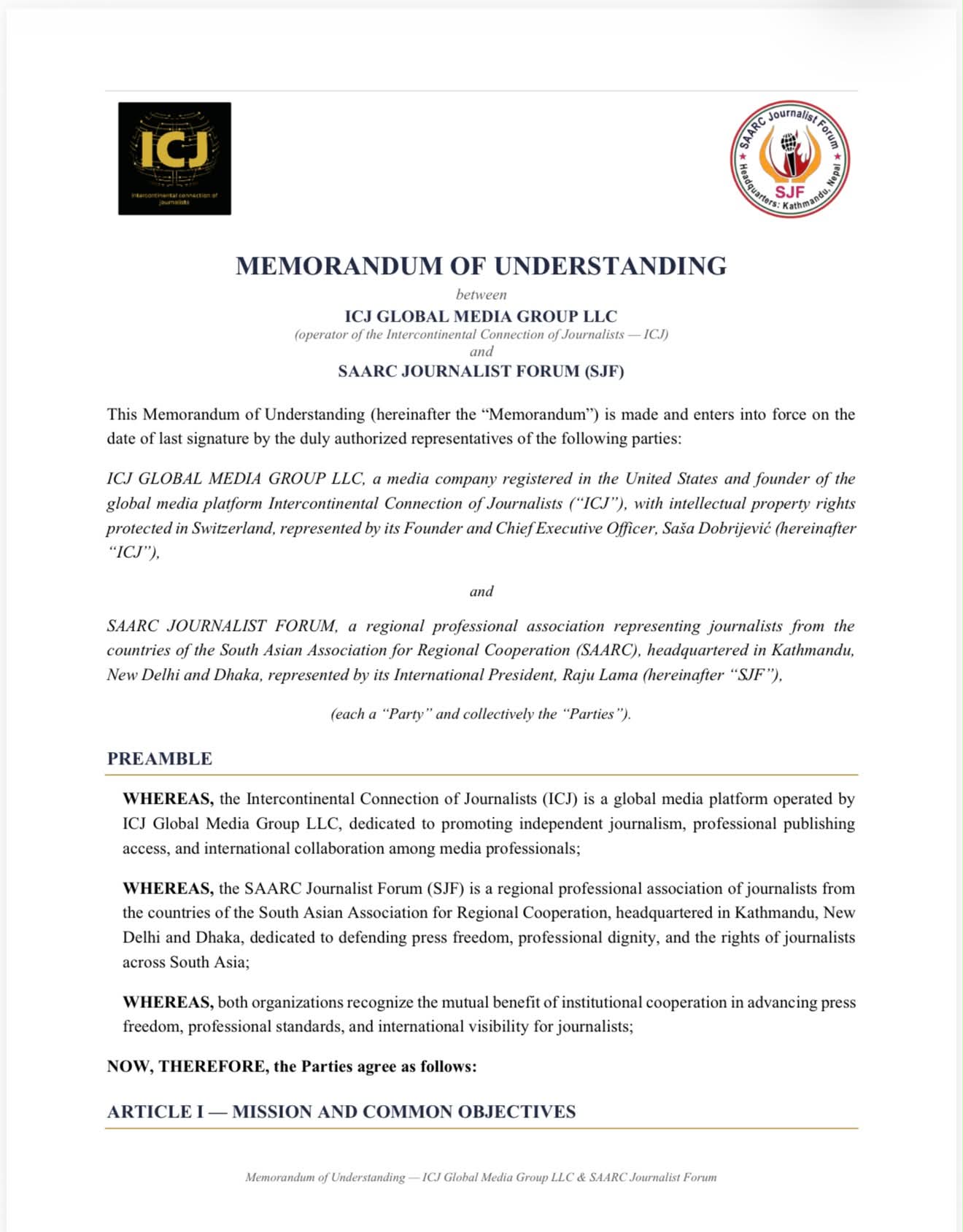
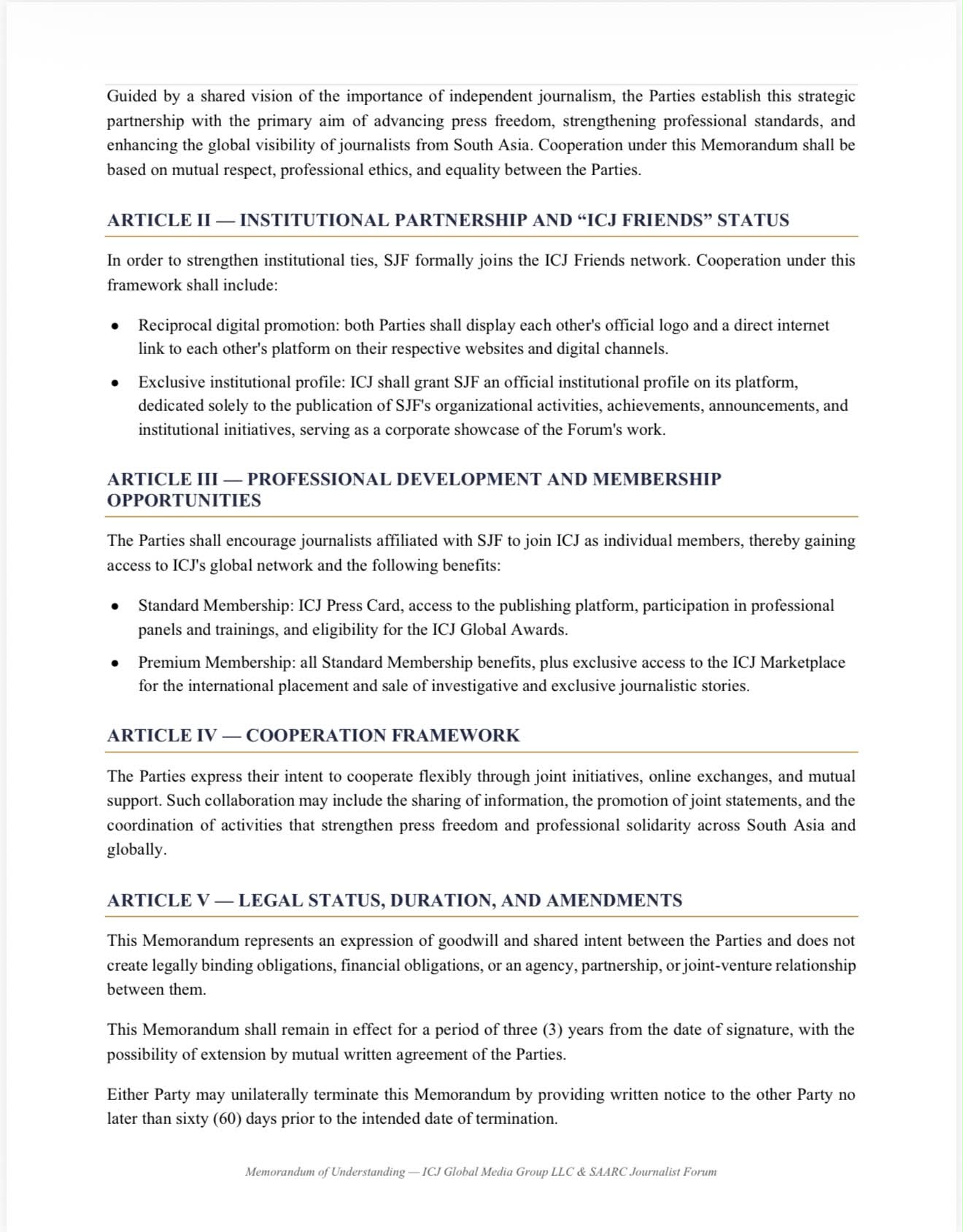
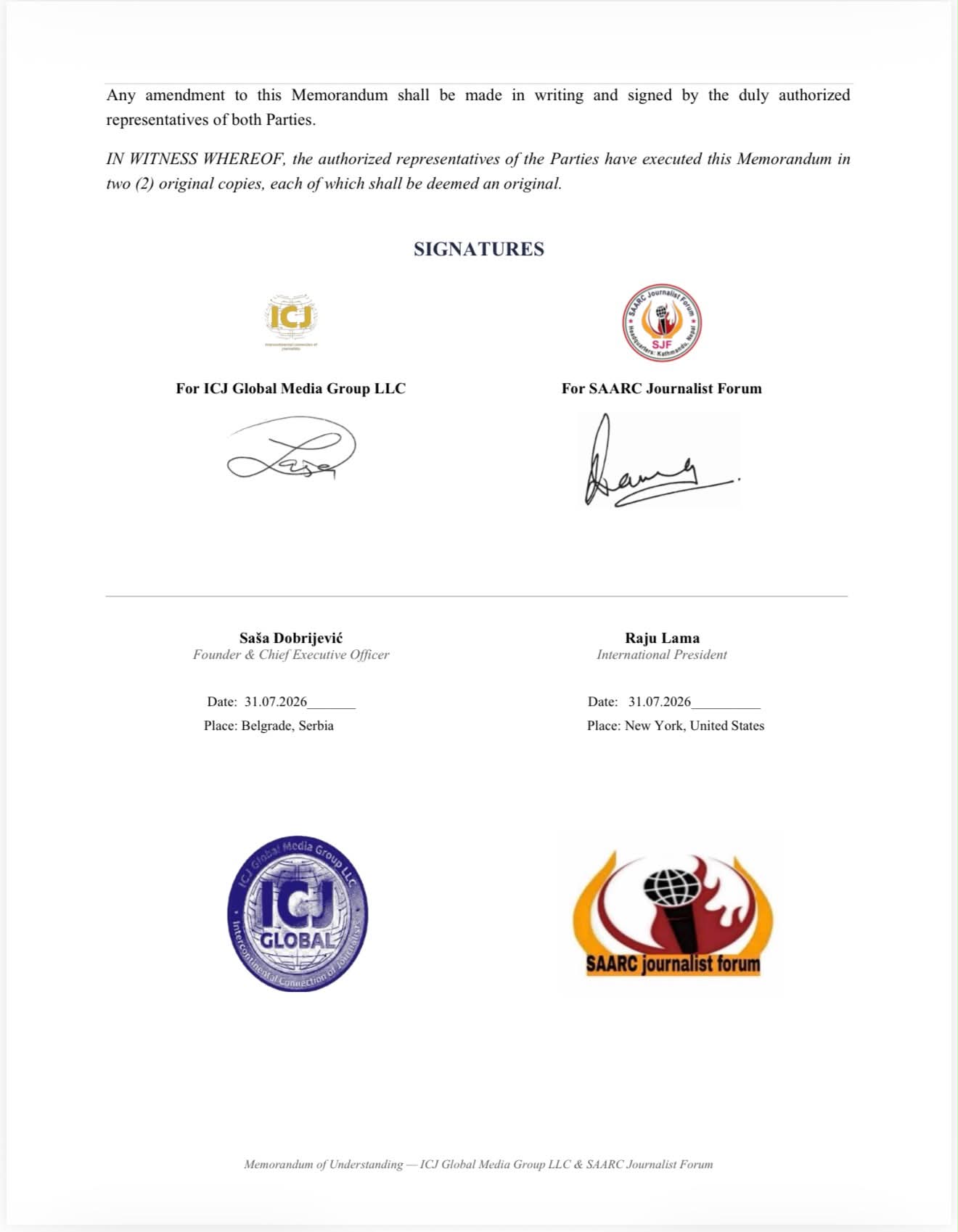 Under the agreement, the SAARC Journalist Forum will join the ICJ Friends institutional network. The partnership includes reciprocal digital promotion, with both organizations displaying each other’s official logos and website links, as well as the creation of an official institutional profile for SJF on the ICJ platform to showcase its activities, achievements, and initiatives.
The MoU also encourages SJF-affiliated journalists to become ICJ members, providing access to an international media network, professional training, publishing opportunities, press credentials, participation in global media panels, and eligibility for ICJ awards. Premium members will also gain access to the ICJ Marketplace for the international distribution of investigative and exclusive journalism.
The agreement outlines cooperation in joint projects, information sharing, online exchanges, and coordinated initiatives designed to strengthen media solidarity across South Asia and globally. It further clarifies that the MoU is an expression of goodwill and does not create legally binding financial or commercial obligations between the two organizations.
The partnership will remain in effect for an initial period of three years, with the option of renewal by mutual written agreement. Either party may terminate the agreement by providing 60 days’ written notice.
The signing of the MoU marks a significant milestone in expanding international media cooperation, creating new opportunities for journalists in the SAARC region to engage with a broader global network while reinforcing the shared values of press freedom, ethical journalism, and professional development.
Posted: April 5, 2026 by admin_raju Leave a Comment
Peace Journalism in South Asia: The Role of SAARC Journalist Forum and the Way Forward
In today’s geopolitical landscape, journalism is no longer confined to the mere dissemination of information; rather, it has emerged as a powerful tool for maintaining peace and stability. Moving beyond traditional “war journalism,” which often amplifies conflict, the concept of “peace journalism” is now widely recognized across the globe. In the SAARC region, the SAARC Journalist Forum (SJF) has set a unique example by institutionalizing peace journalism and fostering regional unity among member countries.
What is Peace Journalism?
Peace journalism is an approach that analyzes the root causes of conflict and seeks to reduce violence and disputes. Instead of fueling tensions, it emphasizes solutions and promotes understanding. Given the social, political, and geographical realities of SAARC countries, the importance of this form of journalism is immense.
Importance of Peace Journalism: Peace journalism promotes tolerance and mutual respect in society. It plays an effective role in reducing rumors, hate speech, and division. Particularly in conflict-prone situations, it helps build understanding among people and contributes to preventing violence.
In a world increasingly marked by conflict, violence, and division, journalism’s role extends far beyond reporting—it actively contributes to peacebuilding and social stability. The concept of peace journalism was popularized by renowned Norwegian peace researcher Johan Galtung, who emphasized that news reporting should not escalate conflicts but instead open pathways for resolution.
Unique Role of SAARC Journalist Forum (SJF):
Over the years, the SAARC Journalist Forum has been actively working to protect democracy, ensure human rights, and promote peace across South Asia.
Key initiatives reflecting the ideals of peace journalism include: International Seminars and Conferences:
SJF has organized multiple international conferences in Nepal, India, Bangladesh, and Sri Lanka, spreading the message of peace among journalists. These events emphasized the principle: “We want peace, not war.”
Human Rights and Democracy:
SJF consistently advocates for journalist safety and press freedom in South Asia. It engages with policymakers to strengthen democratic institutions and ensure the rights of ordinary citizens.
Regional Solidarity:
By connecting journalists from India, Pakistan, Bangladesh, Nepal, Sri Lanka, Bhutan, and the Maldives, SJF acts as a bridge to reduce regional hostility and enhance cooperation.
Recognition from Sri Lanka:
The contributions of SJF in promoting peace have recently been recognized by Sri Lanka through a special honor awarded to its leadership. This recognition is not merely a personal achievement but a testament to the growing global relevance of peace journalism and the impactful work of SJF. Such acknowledgment inspires journalists across South Asia to adopt more responsible and humane practices.
Major International Conferences in Delhi (February 2026):
In February 2026, SJF organized several significant international events in New Delhi aimed at promoting peace journalism and regional cooperation:
1. Media Conclave: Security and Development (Shyam Lal College, University of Delhi), held on February 7, 2026, this conclave focused on the role of media in ensuring regional security and development. Discussions emphasized responsible reporting that supports stability rather than undermining national security.
2. International Peace Conference (Bharati Vidyapeeth, New Delhi):
Held on February 8, 2026, under the theme “Role of Journalism in Peacekeeping and Cooperation in South Asian Countries,” this conference highlighted journalism as a tool for peacebuilding and regional collaboration.
3. South Asian Heroes Award:
On February 6, 2026, distinguished media personalities were honored for their contributions to peace. This recognition significantly boosted morale among journalists working in peace journalism.
Key Outcomes of the Conferences
Encouraging solution-oriented reporting instead of provocative narratives:
– Strengthening SJF’s role in regional peacebuilding
– Ensuring journalist safety and press freedom
– Raising awareness against misinformation and hate speech on social media
These events reinforced the idea that sustainable development in South Asia is impossible without peace—and journalists are key architects of that peace.
Reflection of Regional Leadership on the Global Stage:
The participation of Raju Lama, International President of SJF, in global platforms such as the United Nations symbolizes the representation of South Asian journalists at the highest level. It highlights the growing international recognition of the region’s media in promoting peace.
His presence emphasized that journalists are not merely reporters of conflict but can act as mediators and facilitators of peace.
Policy-Level Engagement:
Participation in global forums like the UN provides opportunities to engage directly with international policymakers on issues of peace and human rights. This will contribute to strengthening press freedom and journalist protection in the SAARC region.
A Matter of Pride for South Asia: Recognition from Sri Lanka and participation in global forums demonstrate that under the leadership of Raju Lama, SJF is evolving from a regional body into a global force for peace advocacy.
Conclusion:
There is no alternative to mutual trust and cooperation among South Asian nations for achieving peace and development. Through its writing and organizational efforts, the SAARC Journalist Forum is building that trust.
The courageous role played by SJF in promoting peace journalism serves as a powerful inspiration for future generations of journalists. If journalists choose to promote peace instead of conflict, a prosperous and secure South Asia can truly be achieved.
Md. Abdur Rahman
Secretary General
SAARC Journalist Forum (Central Committee)
Kathmandu, Nepal
Website: www.sarcjournalistforum.org
Last Updated: January 9, 2026 by admin_raju Leave a Comment
International Conference on Mother Language & Award 2026 was held in Nalanda
Nalanda. The international conference was jointly organized by Nalanda Open University and SAARC Journalists Forum (SJF) in Rajgir, a traditional tourist destination in Bihar.
The two-day international conference titled ‘International Conference on International Mother Language & International Award-2026’ was held on January 4 and 5 at the International Conference Hall of Nalanda Open University.
Former Vice-Chancellor of Nalanda University Professor K. C. Sinha, eminent writer and cultural activist of Mauritius Dr. Sarita Budhu participated as the chief guests of the event. Former Governor of Sikkim Hon. Shri Ganga Prasad inaugurated the conference.
Special guests were present, President of the Central Committee of SAARC Journalists Forum Raju Lama and Secretary General Md. Abdur Rahman. Along with SJF leaders Nripendra Lal Shrestha, Rudra Subedi, Raju Napit, Dependra Prajapati, Saddab Malik from Nepal were also present in conference.
Representatives from five South Asian countries, India, Bangladesh, Nepal, Sri Lanka and Bhutan, Thailand, America and Mauritius, participated in this international conference, and about two hundred prominent journalists, academicians, human rights activists and cultural figures participated.
The first session of the program: “Journalism and Human Rights: A Global Challenge” was discussed. Sri Lanka’s Rahul Samantha joined it through video conference.
The second session: Renowned writer Professor Pratiyo Das and others spoke on “Educational Importance of Nalanda University”.
The third session: Former Vice Chancellor of Patna and Nalanda University, Professor K. C. Sinha, discussed “Culture and Mother Tongue of Bihar”.
The international conference mainly discussed in detail and exchanged experiences on the importance of mother tongue in the world, protection of human rights, practice of democracy and freedom of the press.
The second session of this international conference was presided over by Dr. Shashi Bhushan Kumar, President of SAARC Journalists Forum Bihar Chapter, and ‘News Human Rights Media House’ was the special supporter of the event.
The international conference was held on the topics of peace, stability, importance of mother tongue, human rights and freedom of the press in the geopolitical context of South Asia.
The conference discussed the role of SAARC or South Asian Association for Regional Cooperation in order to increase peace, stability and mutual cooperation in the geopolitical context of South Asia.
Regional peace in South Asia has largely stalled due to various political and bilateral problems.
The discussions of journalists at this international conference revealed that a strong foundation should be created to increase harmony and brotherhood among the 8 countries of South Asia.
The spirit of the language movement and its international context :
The language movement of Bangladesh in 1952 is no longer just the history of a country, it is a symbol of global recognition as the International Mother Language Day. The meaning of highlighting it at the conference is to remind the world that the fight to protect one’s own culture and identity is a fundamental right of any nation.
The role of journalists in the context of human rights and press freedom is currently very challenging. This issue came up in the discussion. Journalists should maintain objective journalism even in adverse environments. Ensuring the safety of journalists and removing obstacles to freedom of expression Strengthening the media as the ‘fourth pillar’ in protecting human rights was called upon the governments of South Asia. After the program, a special cultural program was held in the evening with artists from SAARC countries.
At the program, distinguished individuals were awarded for their outstanding contributions in various fields:
Life Time Award 2025: Dr. Sarita Budhu, Padma Shri Dr. J. K. Singh, Dr. Brajanandan Kumar Sinha and Dr. Sushmita Pandey were awarded this award.
Nalanda International Achievers Award:
A total of 21 distinguished personalities, including four journalists from Bangladesh, were awarded this award.
Bihar Gaurab Award: 51 individuals were awarded this award, including the ‘Gold Man of India’ Prem Singh.
On the second day of the event, representatives of SAARC countries visited the ruins of the ancient Nalanda University, a thousand-year-old monument.
Five senior journalists from Bangladesh participated in this important international conference, Mustaq Ahmed Mubaraki: Editor, Dainik Bangabani and former Director, Bangladesh Sangbad Sangstha (BSS), Mohammad Moniruzzaman: Editor, Dainik Bank Bima Economise, Kazi Habib Ullah: Chief Reporter, The Morning News.
Posted: June 19, 2025 by admin_raju Leave a Comment
Declaration : SAARC Nations Urged to Back Journalism in Mother Tongues
Kathmandu. SAARC countries have been urged to formulate inclusive media policies to protect and promote journalism in mother tongues. The call came through a seven-point resolution adopted in the Kathmandu Declaration at the closing of a two-day International Conference on Mother Tongue Journalism. The declaration stressed the need for state support and policy-level commitment from SAARC heads of government. It recommended allocating increased budgetary support to develop and sustain media outlets operating in local and indigenous languages.
 The resolutions also called for recognising tribal and indigenous language journalism as a tool for cultural preservation and social justice. It emphasised ensuring these communities have access to platforms to voice their concerns and receive relevant information.
 Organised by the National Forum of Newar Journalists in collaboration with the SAARC Journalist Forum (SJF) and the Federation of Nepal Indigenous Journalists (FONIJ), the conference brought together journalists from across the region.
 The event was inaugurated by Nepalese Speaker Devraj Ghimire on Friday and concluded by Madhyapur Thimi Municipality Mayor Surendra Shrestha on Saturday.
 The declaration also recommended regular training programmes, workshops, and fellowships for mother tongue journalists. It appealed to UN agencies and development partners to prioritise support for mother tongue journalism in terms of funding, technical assistance, and capacity building.
 Speaking the function, SJF President Raju Lama urged all stakeholders to take immediate steps to implement the resolutions and called on SAARC governments to support future initiatives.
 FONIJ President Lucky Chaudhary, SJF Secretary General Md Abdur Rahman (Bangladesh), SJF Bihar Chapter President Dr Shashi Bhushan Kumar, conference coordinator Sunil Maharjan, and NFNJ Secretary General KK Manandhar also highlighted the importance of preserving and promoting native language journalism.
 The declaration noted that the resolutions would be officially submitted to the heads of SAARC nations, with a strong appeal to increase national budget allocations and promote awareness through sustained dialogue with stakeholders.
At the closing ceremony, Mayor Shrestha said the conference had significantly contributed to the promotion of mother tongue journalism.
Posted: April 28, 2025 by admin_raju Leave a Comment
Urgent SAARC dialogue needed to ensure stability in South Asia : SJF
Jaipur, Indian state Rajasthan, Apr 26 (UNB): A renewed dialogue among SAARC leaders must begin immediately to foster peace, stability, and mutual cooperation across South Asia, speakers urged at an international conference held at Apex University in Jaipur, Rajasthan, on Saturday.
They emphasised that the SAARC Journalists Forum – an organisation comprising journalists from the SAARC nations – can play a crucial role in facilitating this process.
The two-day conference, titled “The Role of Journalism for Peace and Stability in South Asia”, was jointly organised by the SAARC Journalists Forum, India Chapter, and Apex University.
Raju Lama, President of the Forum’s Central Committee based in Nepal, warned that South Asia is steadily drifting towards instability, raising fears of potential conflict.
“The situation could worsen if urgent steps are not taken,” he cautioned. Recalling a rare moment of diplomatic warmth at the 2016 SAARC summit, when Indian Prime Minister Narendra Modi and Pakistani Prime Minister Nawaz Sharif shook hands, Lama said Nepal has consistently worked for peace and remains committed to promoting dialogue among SAARC leaders.
Addressing the conference, Apex University Pro-Vice Chancellor Dr Khemraj Chowdhury stressed that the urgency for cross-border dialogue among South Asian nations has never been greater.
“It is no longer possible to establish peace through arms. We must awaken people’s conscience and foster values that promote harmony,” he said.
Dr Chowdhury added that journalists have a significant responsibility to build public pressure through accurate and ethical reporting, reminding attendees that many wars throughout history have ended through dialogue.
In a session focused on the challenges and prospects of journalism in South Asia, Prof Rakesh Goswami of the Indian Institute of Mass Communication (IIMC) highlighted the growing threat of misinformation. “Today, social media spreads information rapidly, often without verification or responsibility, shaping public opinion before the truth emerges,” he said.
He cautioned that widespread misinformation and disinformation on social platforms have become major challenges for traditional media. Raising awareness about the dangers of false information is now more important than ever, he added.
Representing Bangladesh, Rafiqul Islam Azad, former President of the Dhaka Reporters Unity, observed that freedom of expression and the health of the media are closely tied to the strength of democracy in each country across the region.
“When democracy is weakened, freedom of the media and freedom of speech suffer alongside it,” he said.
The conference drew journalists, academics, communication experts, and journalism students from across SAARC member countries, all of whom shared a common belief: journalism can and must play a pivotal role in promoting peace, understanding, and cooperation in South Asia.
Recent Posts
Recent Comments
Archives
Categories