Indore : The 18th edition of the three-day Indian Journalism Festival 2026 has been concluded on October 4, at the Jaal Sabhagriha in South Tukoganj, Indore.Organized by the State Press Club, Madhya Pradesh, the prestigious national gathering has brought together over 150 prominent journalists, editors, and digital media experts from across the country.This year’s festival centers around the theme “Gen-Z” and its influence on print, electronic, and digital media. The event pays rich tribute to the “Saptarishis” (seven legendaries) of Hindi journalism: Late Rahul Barpute, Rajendra Mathur, Prabhash Joshi, Manikchandra Vajpayee, Rameshchandra Agarwal, Abhay Chhajlani, and Krishnakumar Ashtana.
Key Dignitaries & Guests
The grand opening ceremony featured distinguished guests, J K Maheswori Justice of Supreme Court of India as the Chief Guest alongside Umang Singhar, Leader of the Opposition in the Madhya Pradesh Legislative Assembly, Bijay Manohar Tiwari VC of Makhanlal University, MDH Chairman Rajiv Gulati as a Special Guests.International media leaders also graced the event, with SAARC Journalist Forum President Raju Lama and Secretary General MD Abdur Rahman along with Gautam Lahiri President of Federation of Press Club, Prakash Nanda, Secretary General of Correspondent Club of India also participated as Special Guests.The announcements were highlighted by Festival Coordinator Sudesh Tiwari, Program Director and State Press Club MP President Praveen Khariwal, and Chief General Secretary Navneet Shukla. Saptarishi Awards Announced
A highlight of the festival is the presentation of honors recognizing excellence and lifelong contributions to journalism:Saptarishi Lifetime Achievement Award:
73-year-old senior editor Devpriya Awasthi is being honored with this prestigious award, instituted in memory of the legendary poet and literary icon Late Naresh Mehta.National Journalism Awardees:
State Journalism Awardees:Girish Upadhyay, Prakash Bhatnagar (Anadi TV), Deshdeep Saxena (The Wildlife.com), Sharad Dwivedi (Bansal News), Sudhir Dixit (News18 MP-CG), Prabhu Pateriya (Swaraj Express SMBC), Shifali (ETV Bharat Digital), Shruti Tomar (Hindustan Times), Rajesh Sharma (Dainik Bhaskar Digital), Shashikant Trivedi, Bhavna Shukla (The Hitavada), and Pankaj Shukla (Subah-Savere).In three days, panel discussions, media summits, and interactive sessions have addressed the evolving landscape of Indian journalism and in the digital era.
Kathmandu, September 27, 2026 — The SAARC Journalist Forum (SJF) has expressed its solidarity with the ICJ Declaration on the Official Status of Professional Journalists, an international initiative launched by the Intercontinental Connection of Journalists (ICJ) to strengthen recognition, protection and professional safeguards for journalists worldwide.
The ICJ Declaration responds to growing risks faced by journalists working in conflict zones, crisis areas, protests and other high-risk environments. It proposes a framework under which verified professional journalists would receive internationally recognized status and enhanced protection while carrying out legitimate journalistic duties.
The Declaration calls for professional journalists meeting defined standards of credentials, professional experience, ethical conduct and independent reporting to be eligible for recognition. It also proposes an international verification and accreditation mechanism, including a possible Global Registry of Verified Journalists under an independent international body.
Under the proposed framework, journalists could receive greater protection during armed conflicts, civil unrest and other dangerous situations, as well as improved access to public information and major international events. The Declaration also proposes mechanisms for emergency assistance, insurance and compensation in cases involving injury, detention or death.
The SAARC Journalist Forum welcomes the initiative as an important contribution to the international discussion on journalist safety, press freedom and professional recognition. SJF believes that journalists must be able to perform their public-interest responsibilities without intimidation, violence or unjustified interference, while maintaining the highest standards of accuracy, independence and professional ethics.
SJF also emphasizes that enhanced recognition and protection of journalists must go together with professional responsibility. The ICJ Declaration itself calls on recognized journalists to uphold truth, accuracy and fairness, respect human dignity and cultural diversity, reject corruption and manipulation, and remain accountable to professional and ethical standards.
The solidarity comes in the context of the formal strategic partnership between the ICJ Global Media Group and the SAARC Journalist Forum, established through a Memorandum of Understanding signed by SJF International President Raju Lama and ICJ Founder and CEO Saša Dobrijević. The partnership brings together journalists from South Asia and the wider international media community around cooperation, press freedom and journalist protection.
Raju Lama, International President of the SAARC Journalist Forum, said that international cooperation among journalists’ organizations is increasingly important as journalists face risks that cross national borders.
“SAARC Journalist Forum stands in solidarity with initiatives that seek stronger professional recognition, safety and dignity for journalists. The protection of journalists is essential to the public’s right to receive reliable information. At the same time, such protection must be accompanied by professional ethics, accountability and respect for the principles of independent journalism,” Lama said.
SJF said it looks forward to continued dialogue with ICJ and other international journalism organizations on practical mechanisms for journalist safety, professional accreditation, cross-border cooperation and the protection of media workers.
The Forum further encouraged journalists’ organizations, press associations, international institutions and governments to participate constructively in the global discussion surrounding the proposed ICJ Declaration. SAARC Journalist Forum reiterates its commitment to international solidarity among journalists and to the protection of press freedom, professional journalism and the safety of media workers across South Asia and beyond.
Indore, India, September 26, 2026 — SAARC Journalist Forum International President Raju Lama and Secretary General Md Abdur Rahman are set to attend the 18th Bhartiya Patrakarita Mahotsav, scheduled to be held from October 2–4, 2026, at Jall Auditorium, Indore, Madhya Pradesh.
Organised under the theme “Celebration of the Identity and Dignity of Words”, the three-day journalism festival will bring together journalists, editors, media professionals and representatives of journalist organisations for discussions on the changing landscape of Indian journalism.
A major theme highlighted for the 18th edition is “Gen-Z Journalism”, focusing on how the younger generation is shaping journalism, news consumption and communication in the digital era. The programme also highlights questions surrounding the future of journalism, professional responsibility and the evolving role of the press.The participation of Raju Lama and Md Abdur Rahman will provide an international and South Asian perspective to discussions at the festival. Representing the SAARC Journalist Forum, they are expected to engage with journalists and media organisations from India and other parts of the region and discuss issues concerning press freedom, journalist safety, regional media cooperation and the future of journalism in South Asia.
The SAARC Journalist Forum has been working to strengthen cooperation among journalists and media organisations across the South Asian region. Lama’s participation also comes in the context of his wider engagement with international journalism organisations and media platforms.
The Bhartiya Patrakarita Mahotsav Season 18 is scheduled for October 2, 3 and 4, 2026, in Indore. The State Press Club, Madhya Pradesh presents the festival as a platform bringing together journalist organisations.
Jamalpur, Munger, Bihar (India), September 22, 2026 – The International Media Summit-2026 (Global Media Summit-2026) was held in Jamalpur, Munger district of India, with the objective of strengthening dialogue, cooperation and experience-sharing among journalists and media professionals across South Asia.
Organized by the All India Journalists Union (AIJU), India, the summit was held at Siddhi Vinayak Marriage Hall in Jamalpur. Indian Rajya Sabha Member of Parliament Dr. Bhim Singh attended the event as the chief guest, while Munger MLA Pranav Kumar was also present as a special guest.
The summit was chaired by Ranjit Samrat, National President of the All India Journalists Union, India. Journalists and media professionals from Nepal, India, Bhutan, Bangladesh and Sri Lanka participated in the event, including Raju Lama, President of the SAARC Journalists Forum International, and Secretary General Abdur Rahman.Addressing the gathering, chief guest Dr. Bhim Singh said journalism is an important medium connecting society with information, ideas and facts. He emphasized that international cooperation among media professionals can contribute to making journalism more responsible and effective. Dr. Singh said, “Journalism is an important pillar of democracy. Although our borders are different, the responsibility and objective of journalists is to provide society with truth, facts and accurate information. Dialogue and cooperation among journalists in South Asia can make an important contribution to strengthening the journalism sector.”
Similarly, SAARC Journalists Forum International President Raju Lama stressed the need for regular dialogue and cooperation among journalists from South Asian countries. He said international conferences such as the Jamalpur summit provide an opportunity for journalists to understand each other’s experiences and collaborate on common issues. Lama said, “Relations among South Asian journalists should not be limited to the exchange of news. Cooperation is also necessary on issues such as journalists’ rights, professional safety, press freedom and common challenges facing the media sector. The conference in Jamalpur has created a new environment for such dialogue.”
The summit was attended by SAARC Journalists Forum Nepal Chapter Convener Rudra Subedi, Co-Convener Md. Arif Ansari, Bihar Chapter President Dr. Shashi Bhushan Kumar, Madhesh Chapter Coordinator Md. Sadab Malik, and members Ramesh Chandra Kumal, Azmat Ali, Sushil Kumar Khadka, Abhilash Gupta, Pawan Prasad Sah and Arun Kalwar, among other journalists and media professionals from different countries.
Participants discussed contemporary issues in journalism and the media sector and exchanged experiences from their respective countries and regions. Discussions focused on challenges facing journalism, developments in communication technology, journalists’ professional safety, international cooperation, and strengthening relations among South Asian media professionals.
The organizers said the first international journalism summit held in Jamalpur has created an important foundation for further strengthening mutual relations, dialogue and cooperation among journalists and media professionals in South Asia.
Participating journalists said the summit brought media professionals from different countries together on a common platform and provided an opportunity to exchange views on shared issues in journalism. They expressed the expectation that the conference would pave the way for more effective cooperation and regular dialogue among South Asian media professionals in the days ahead.
Munger/Jamalpur, Bihar | September 18, 2026 — Senior leaders of the SAARC Journalist Forum (SJF) will participate in the International Patrakar Mahasammelan scheduled to be held on September 20, 2026, in Jamalpur/Munger, Bihar, India.
According to the event announcement, Raju Lama, International President of the SAARC Journalist Forum, and Md. Abdur Rahman, Secretary General of the SAARC Journalist Forum have been invited as Special Guests at the international journalists’ gathering.
The programme is being organized by the All India Journalist Union (Bharat) under the leadership of its National President Ranjit Samrat, in collaboration with the SAARC Journalist Forum.
The day-long programme is scheduled from 10:00 AM to 6:00 PM, with sessions covering the inauguration and introduction, media motivational speeches, guest speeches and an award ceremony, followed by a concluding session.
Platform for South Asian media cooperation
The participation of the SJF leadership is expected to provide an opportunity for journalists and media organizations from India and South Asia to exchange views on contemporary challenges facing journalism, professional cooperation and the role of media in strengthening regional understanding.
Raju Lama has in recent months represented SJF in a number of international journalism and multilateral engagements, including activities connected with the United Nations and international media organizations. SJF has also been pursuing cooperation with journalism organizations beyond South Asia, with a focus on professional exchanges, press freedom and cross-border media collaboration.
For Md. Abdur Rahman, the Munger gathering will add to his recent regional journalism engagements. His participation in various activities involving journalists from Bangladesh, Nepal and other South Asian countries, included discussions on regional media cooperation and professional dialogue.
The International Patrakar Mahasammelan is therefore expected to bring together journalists and media representatives around a common platform for discussion, recognition and networking. The participation of the SAARC Journalist Forum leadership also highlights the growing emphasis on regional journalist-to-journalist cooperation across South Asia.
Kathmandu, September 5, 2026 – SAARC Journalists Forum (SJF) has issued a press release expressing deep outrage and unequivocal condemnation regarding the recent physical assault and inhumane treatment inflicted upon journalists Shaheen Khan and Nafeesa Khan by Delhi police.
According to reports, Shaheen Khan, a journalist working for ‘4PM’, was violently dragged by her hair, slammed to the ground, and subjected to physical assault including kicks and punches while attempting to ask a question to the Chief Minister of Delhi during her professional duties. The SJF described this act as a severe blow to press freedom and a grave violation of fundamental human rights across the South Asian region.In a press statement signed by SJF President Raju Lama, the forum put forward four key demands to the authorities: 1. Independent High-Level Inquiry:Conduct an impartial and transparent investigation under the direct supervision of a sitting Supreme Court judge, while securing all relevant CCTV footage as evidence. 2. Exemplary Punishment for Culprits:Register immediate criminal charges against the police personnel involved in the assault and suspend them pending strict legal action. 3. Justice and Security Assured:Guarantee the full safety and security of the victims, Shaheen Khan and Nafeesa Khan, ensuring complete accountability. 4. Protection of Journalists:Ensure total freedom and safety for media professionals, particularly female journalists, while performing their duties in the line of work.
The SAARC Journalists Forum firmly asserted that any attack on journalists represents a direct assault on the democratic framework and freedom of expression throughout South Asia, pledging its full solidarity with the victimized journalists until complete justice is served.
New York/Kathmandu, August 20, 2026 – International President of the SAARC Journalist Forum (SJF), Raju Lama, undertook a wide range of professional, diplomatic and journalistic activities in the United States from April 10 to August 20, 2026, strengthening the voice of South Asian journalists and expanding SJF’s engagement with international media, diplomatic and multilateral institutions.
During his stay in the United States, Lama focused on promoting press freedom, journalists’ rights, international media cooperation, South Asian issues and the role of journalism in strengthening democracy and regional cooperation.
Engagement with the United NationsOne of the major areas of Lama’s activities in the United States was his engagement with the United Nations and international policy forums in New York.
He attended the 25th Session of the Committee of Experts on Public Administration (CEPA) at the United Nations Headquarters in New York from April 13–17, 2026. The session provided an opportunity to follow discussions on public administration, governance, sustainable development and international cooperation.
Lama also participated in the ECOSOC Forum on Financing for Development Follow-up (FfD Forum) and the SDG Investment Fair, held in New York from April 20–24, 2026. Through these engagements, he followed international discussions concerning sustainable development, financing, global cooperation and the priorities of developing countries and the Global South.
During his UN-related engagements, Lama also maintained contact with diplomats, international officials, journalists and representatives of civil society organizations, promoting greater recognition of the perspectives and concerns of South Asian countries.
Engagement with International Journalism OrganizationsAs President of the SAARC Journalist Forum, Lama also expanded his engagement with international journalism organizations and foreign correspondents in the United States.
He held discussions with Ian Williams, President of the Foreign Press Association of the United States, focusing on the changing environment for foreign journalists working in the United States and recent developments concerning journalists’ visas and media access.
The discussion highlighted the importance of protecting the professional rights of foreign correspondents and maintaining an open environment for international journalism.
Lama also explored opportunities for cooperation between SJF and international journalist organizations, with the objective of developing greater exchanges, professional training, networking and solidarity among journalists from South Asia and other regions.
Advocacy for Press Freedom and Journalists’ Rights Press freedom and journalists’ safety remained central to Lama’s activities throughout his period in the United States.
As International President of SJF, he continued to advocate for the protection of journalists, freedom of expression and an independent media environment across South Asia.
SJF under Lama’s leadership also closely followed developments affecting journalists in Nepal and other South Asian countries, including cases involving arrests, restrictions and threats against members of the media.
The organization’s advocacy emphasized that journalists must be able to perform their professional responsibilities without intimidation, political pressure or unnecessary legal restrictions.
Representation of South Asian Journalism in the United StatesLama used his presence in the United States to promote greater international understanding of South Asian journalism and the challenges facing journalists in the region.
Through meetings, professional networking and participation in international events, he emphasized the need for stronger cooperation between journalists from South Asia, the United States and the wider Global South.
He also promoted the concept of journalism as a bridge between societies, arguing that professional media cooperation can contribute to peace, dialogue, democratic values and regional understanding.
Engagement with Global South IssuesHis participation in UN and ECOSOC-related programs provided an opportunity to follow global discussions on development, financing, governance and international cooperation from a South Asian perspective.
As President of SJF, Lama emphasized that international media discussions should provide greater space to the voices of journalists and communities from developing countries.
He advocated for stronger South-South media cooperation and greater representation of Global South perspectives in international journalism.
International Media and Professional Outreach
Screenshot
During his stay, Lama also continued strengthening the international profile of the SAARC Journalist Forum, which brings together journalists and media professionals from the South Asian region.
He worked toward developing relationships with international journalists, media organizations and professional networks in the United States, with the objective of creating future opportunities for:
* International journalist exchanges * Professional training and capacity building * Joint media programs * Cross-border reporting * Press freedom advocacy * South Asian and Global South journalism cooperation * International conferences and professional forums
These efforts are aimed at making SJF a stronger platform for regional and international cooperation among journalists.
Focus on U.S.–South Asia Media RelationsLama also emphasized the importance of stronger media relations between the United States and South Asia.
He highlighted the significant role of journalists in improving public understanding between the two regions and encouraged greater opportunities for South Asian journalists to participate in international media programs, conferences and professional exchanges in the United States.
His activities also reflected SJF’s broader objective of connecting journalists across geographical and political boundaries while maintaining professional independence and journalistic ethics.
International Conferences and Journalistic NetworkingThroughout the April–August period, Lama maintained professional contacts with journalists, media leaders, diplomats, academics and representatives of international organizations.
He also pursued opportunities for SJF participation in international conferences and journalism forums, including initiatives connected with indigenous journalism, international press freedom and Global South media cooperation.
These activities contributed to expanding the international network of SJF and strengthening its position as a regional platform representing journalists from South Asia.
SJF’s International SolidarityDuring this period, SJF continued expressing solidarity with journalists and media organizations facing professional, legal or political challenges.
Under Lama’s leadership, the organization maintained its position that attacks on journalists, arbitrary detention, threats to media freedom and restrictions on independent journalism should be addressed through professional solidarity and international advocacy.
SJF also continued issuing messages of solidarity and concern on developments affecting journalists in South Asia.
Building International PartnershipsLama’s activities in the United States also focused on identifying opportunities for institutional partnerships between SJF and international journalism organizations.
Potential areas of cooperation included journalist training, professional exchanges, conferences, research, digital journalism, press freedom initiatives and collaboration between regional journalist organizations.
The initiative reflects Lama’s effort to transform SJF from a primarily regional network into a stronger international platform for cooperation among journalists.
Strengthening the International Profile of SJFFrom April 10 to August 20, Lama’s activities in the United States contributed to increasing the visibility of the SAARC Journalist Forum in international media and professional circles.
His participation in UN-related forums, engagement with foreign journalists and international journalism organizations, advocacy for press freedom, and networking with diplomats and international stakeholders provided opportunities to present the priorities of South Asian journalism on a wider international platform.
As International President, Lama emphasized that the challenges facing journalists today are increasingly global and require cooperation beyond national borders.
A Period of International Media DiplomacyThe April–August 2026 period can therefore be described as an important phase of international media diplomacy for Raju Lama and the SAARC Journalist Forum.
From the United Nations in New York to meetings with international journalists and media organizations, Lama worked to connect South Asian journalism with wider international debates on democracy, development, press freedom, governance and global cooperation.
His activities demonstrated SJF’s commitment to strengthening the professional network of South Asian journalists while promoting dialogue and cooperation with journalists and institutions around the world.
Conclusion
Between April 10 and August 20, 2026, SAARC Journalist Forum International President Raju Lama used his professional presence in the United States to promote South Asian journalism, press freedom, journalists’ rights and international media cooperation.
His participation in UN and ECOSOC-related programs, engagement with international journalists and media organizations, advocacy for journalists, and efforts to build international partnerships have helped broaden the international outreach of the SAARC Journalist Forum.
The activities represent an important step toward strengthening South Asia–United States media relations and building a wider Global South journalism network, with SJF positioned as a platform for professional solidarity, dialogue and cooperation among journalists.
Kathmandu, August 20, 2026 — The SAARC Journalist Forum (SJF) has expressed its solidarity with the Society of Professional Journalists (SPJ), the Arab & Middle Eastern Journalists Association, the Committee to Protect Journalists (CPJ), the Foreign Press Association of the USA and other journalism and press-freedom organizations opposing new U.S. Department of Homeland Security (DHS) restrictions affecting foreign journalists.
The coalition is urging the U.S. Congress to block the new DHS rule that would replace the longstanding practice of admitting foreign journalists for the duration of their assignments with fixed admission periods. The rule is scheduled to take effect on September 15, 2026, although its implementation could still be affected by congressional or legal action.
Under the new framework, foreign journalists holding I visas could face a maximum admission period of 240 days, while Chinese journalists would face a shorter initial period of 90 days, according to reporting on the rule and the legal challenge brought against it.
The SAARC Journalist Forum said it stands firmly with the international and U.S.-based journalism organizations that have raised concerns that such restrictions could undermine independent journalism, international press coverage and the free flow of information.
“The SAARC Journalist Forum stands in solidarity with the Society of Professional Journalists and all organizations defending the rights and professional freedom of foreign correspondents. Journalism must not be weakened by policies that make it unnecessarily difficult for journalists to report from the United States,” SJF International President Raju Lama said.
The SJF emphasized that foreign correspondents play an important role in helping audiences around the world understand U.S. politics, society, economy, science, culture and international affairs. Limiting their ability to remain in the country for the duration of legitimate professional assignments could reduce the depth, continuity and diversity of international news coverage.
The coalition statement highlighted concerns that the restrictions could damage the United States’ reputation as a global center for press freedom and could result in less nuanced international understanding of the country and its institutions.
The SJF also welcomed the growing legal and professional response to the new policy. On August 18, a coalition of unions and advocacy organizations filed a federal lawsuit challenging the new visa restrictions, arguing that the changes could seriously harm foreign journalists and other affected nonimmigrant groups.
The SJF called on the U.S. Congress and the DHS to reconsider the restrictions and ensure that legitimate foreign journalists can continue their professional assignments without unnecessary barriers.
The Forum stressed that press freedom is a universal principle and that journalists from South Asia and other regions should be able to report independently and professionally on matters of international importance.
The SAARC Journalist Forum reaffirmed its commitment to working with international journalism organizations to defend journalists’ rights, promote freedom of expression and strengthen cross-border cooperation among media professionals.
Thimphu, Bhutan: A delegation of SAARC Journalist Forum (SJF) from Bangladesh Chapter Sunday called on Rinzin Wangchuk, a Central Executive Member of the SJF. The delegation visited Bhutan at the invitation of Rinzin Wangchuk and held a meeting with the executive committee member at Thimpu.
During the meeting, they exchanged views on various issues centering enhancement of mutual cooperation among saarc journalists from member countrie.
They discussed issues, especially the problems the member countrirs are now facing, and stressed the need for more cooperation from respective governments to overcome the problems and help them to develop skills and discharge their responsibilities efficiently with due honour.
Development training focusing AI (Artificial Intelegance) for SAARC members as well as the importance of fostering peace, democracy, and press freedom across South Asia were also hilighted in the meting.
Since it inception SAARC Journalist Forum through various conferences and seminars urged concerned authorities and the organization to keep members informed of future initiatives for further strengthening of regional collaboration.
Rinzin Wangchuk is the former President of the Journalists Association of Bhutan and former Editor of Kuensel, the country’s leading national newspaper.
Bangladesh delegation arrived in Thimpu, the capital of Bhutan, on August 15 following their participation in a 4-day International Indigenous Journalism Conference held in Kathmandu, Nepal from August 9 to 12.
Led by senior journalist Md. Ziaur Rahman, the delegation included Md. Abdur Rahman — Secretary General, SAARC Journalist Forum & Senior Correspondent, The Bangladesh Post, Mushtaq Ahmed Mubaraqui — Editor, The Daily Bongobani, Md. Ziaur Rahman — Special Correspondent, The Daily Aajkal, Mohammad Muniruzzaman — Editor, Daily Bank Beema Economics, Panna Zaman — Managing Editor, Daily Amar Bangla, Md. Abu Bakar Siddique — Senior Correspondent, Daily Aajker Provat.
Kathmandu/New Delhi, August 15, 2026 — Raju Lama, International President of the SAARC Journalist Forum (SJF), has extended his warm greetings and best wishes to the Government and people of India on the occasion of the country’s 80th Independence Day.
In his message, Lama praised India’s remarkable journey since independence and acknowledged its significant contributions to democracy, economic development, technological innovation, and regional cooperation in South Asia. He said India’s progress has inspired millions across the region and strengthened the collective aspirations of South Asian nations.
“On behalf of the SAARC Journalist Forum and journalists across South Asia, I extend heartfelt congratulations and best wishes to the people of India on the historic occasion of the 80th Independence Day. This milestone reflects India’s enduring commitment to democracy, diversity, freedom, and development,” Lama stated.
He emphasized the importance of media in safeguarding democratic values and promoting mutual understanding among nations. Lama noted that journalists have a crucial role in fostering peace, combating misinformation, and strengthening people-to-people relations throughout the SAARC region.
The SJF President also highlighted the longstanding cultural, historical, and people-to-people ties among South Asian countries and expressed hope for greater regional cooperation, peace, and prosperity in the years ahead.
He reaffirmed the commitment of the SAARC Journalist Forum to promoting press freedom, human rights, democratic values, and regional harmony.
“May the spirit of freedom, unity, and progress continue to guide India toward greater achievements and contribute to peace and stability in South Asia,” he added.
The SAARC Journalist Forum is an international organization representing journalists from South Asian countries and works to promote press freedom, democracy, human rights, peace journalism, and regional cooperation.


Last Updated: October 6, 2026 by admin_raju Leave a Comment
The 18th Indian Journalism Festival in Indore; Focuses on Gen-Z and Honors Media Stalwarts
Indore : The 18th edition of the three-day Indian Journalism Festival 2026 has been concluded on October 4, at the Jaal Sabhagriha in South Tukoganj, Indore.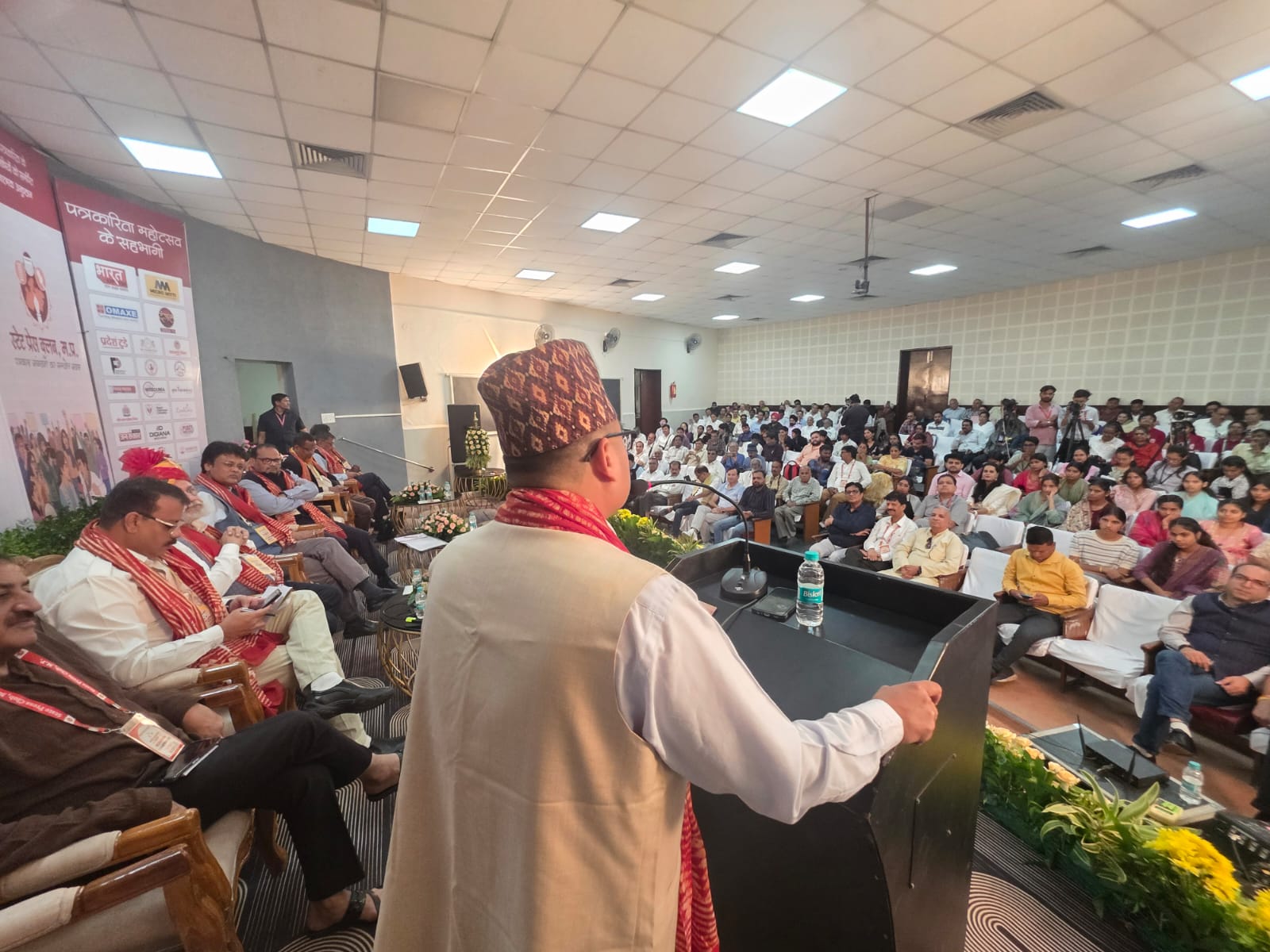 Organized by the State Press Club, Madhya Pradesh, the prestigious national gathering has brought together over 150 prominent journalists, editors, and digital media experts from across the country.
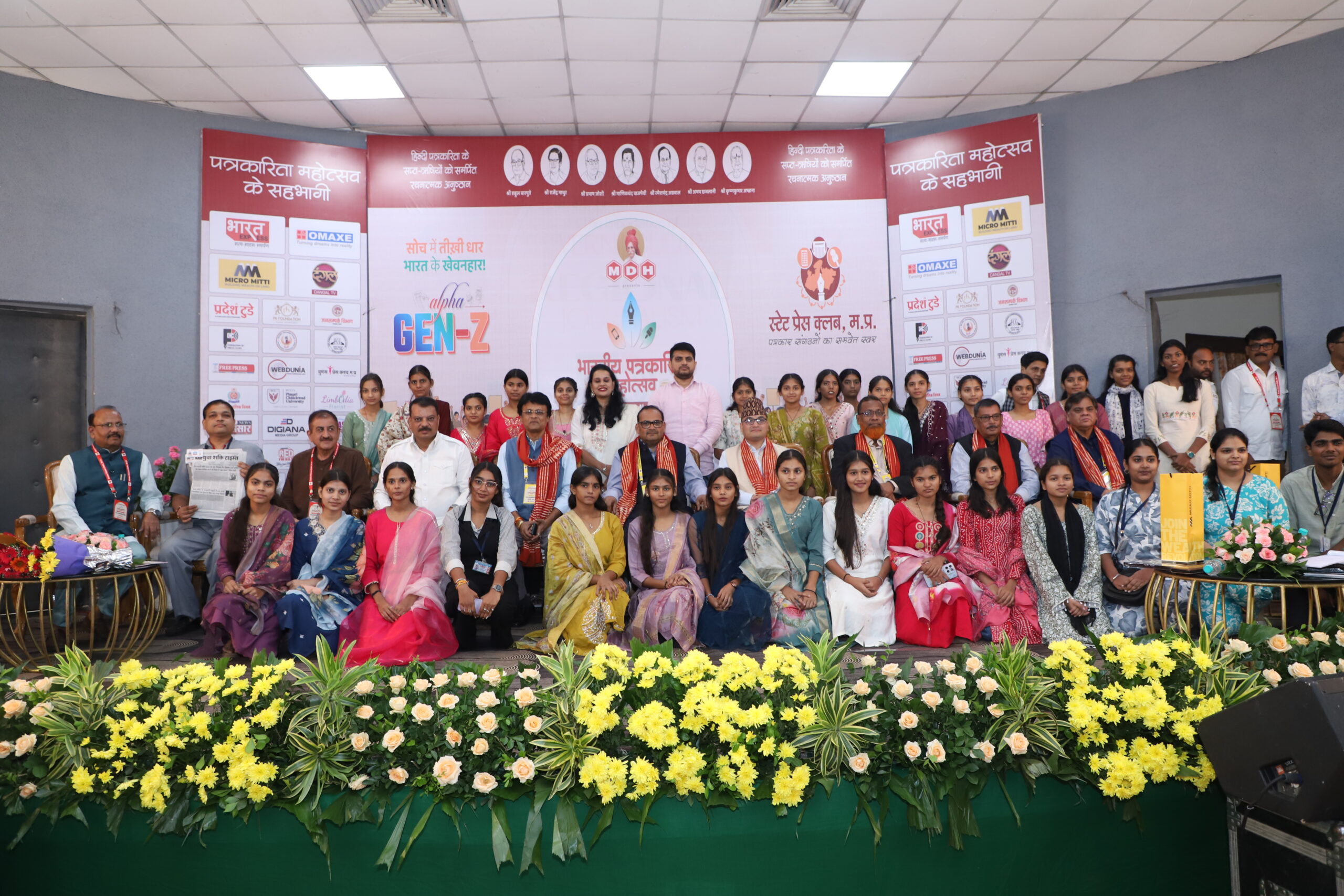 This year’s festival centers around the theme “Gen-Z” and its influence on print, electronic, and digital media. The event pays rich tribute to the “Saptarishis” (seven legendaries) of Hindi journalism: Late Rahul Barpute, Rajendra Mathur, Prabhash Joshi, Manikchandra Vajpayee, Rameshchandra Agarwal, Abhay Chhajlani, and Krishnakumar Ashtana.
Key Dignitaries & Guests
The grand opening ceremony featured distinguished guests, J K Maheswori Justice of Supreme Court of India as the Chief Guest alongside Umang Singhar, Leader of the Opposition in the Madhya Pradesh Legislative Assembly, Bijay Manohar Tiwari VC of Makhanlal University, MDH Chairman Rajiv Gulati as a Special Guests.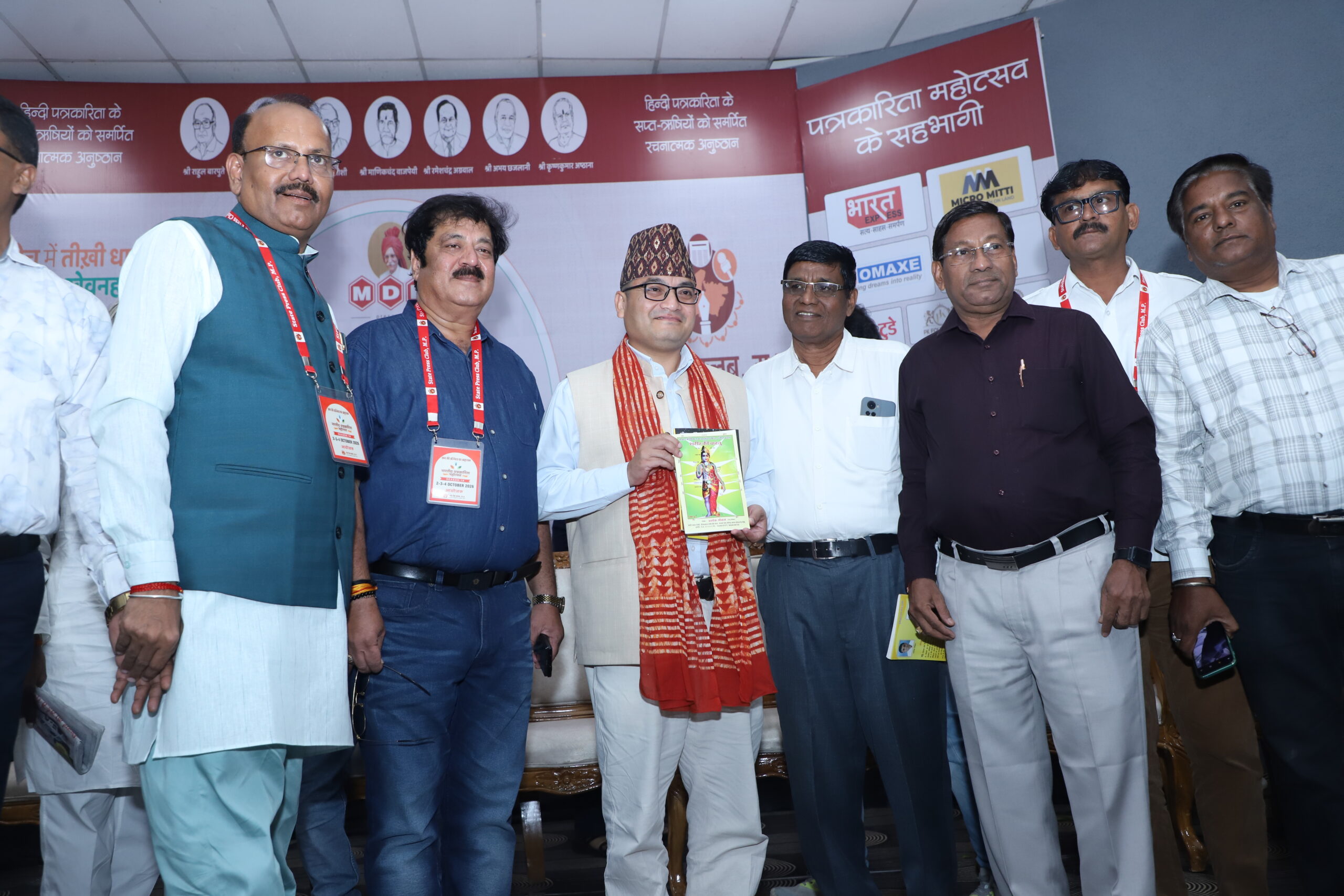 International media leaders also graced the event, with SAARC Journalist Forum President Raju Lama and Secretary General MD Abdur Rahman along with Gautam Lahiri President of Federation of Press Club, Prakash Nanda, Secretary General of Correspondent Club of India also participated as Special Guests.
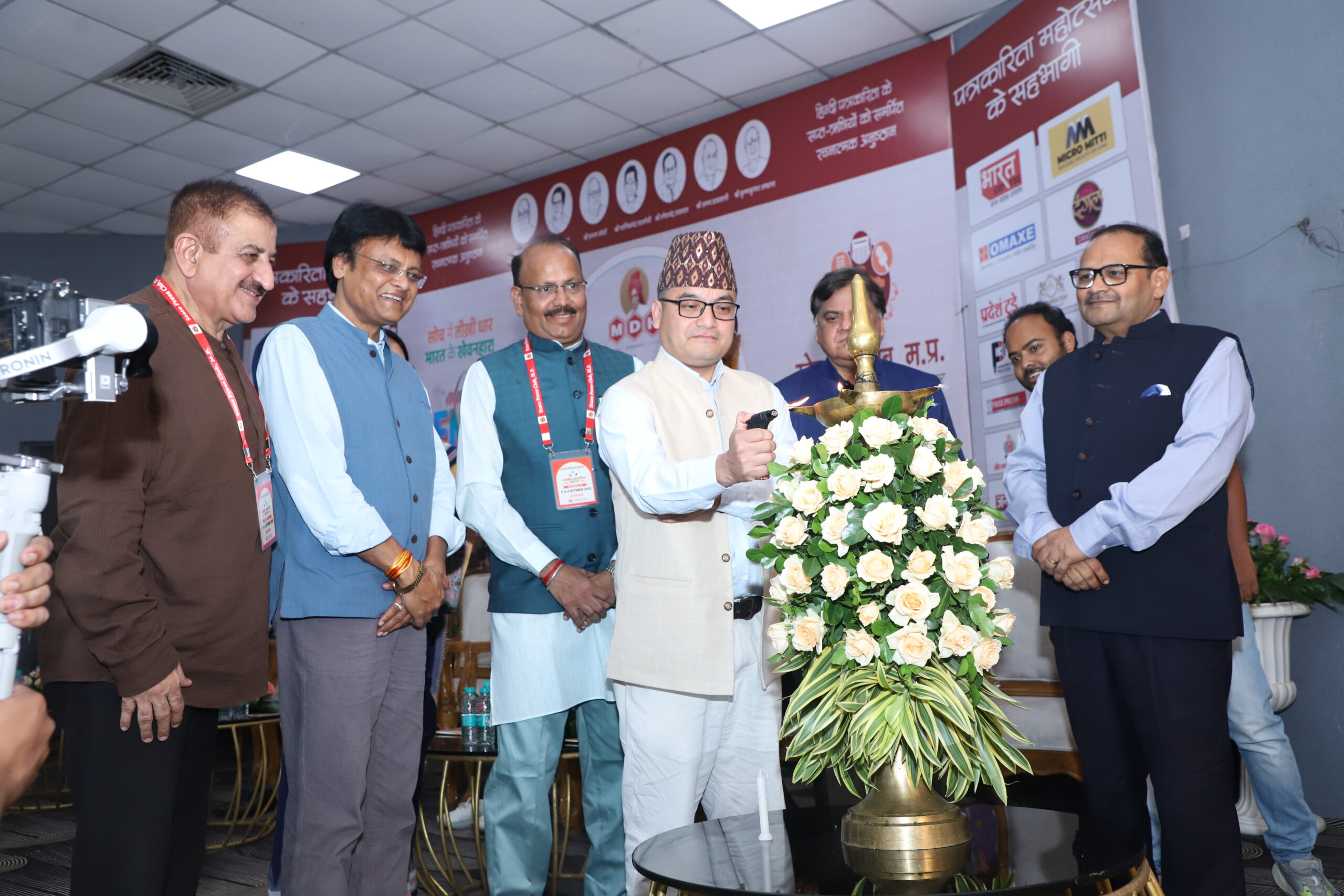 The announcements were highlighted by Festival Coordinator Sudesh Tiwari, Program Director and State Press Club MP President Praveen Khariwal, and Chief General Secretary Navneet Shukla.
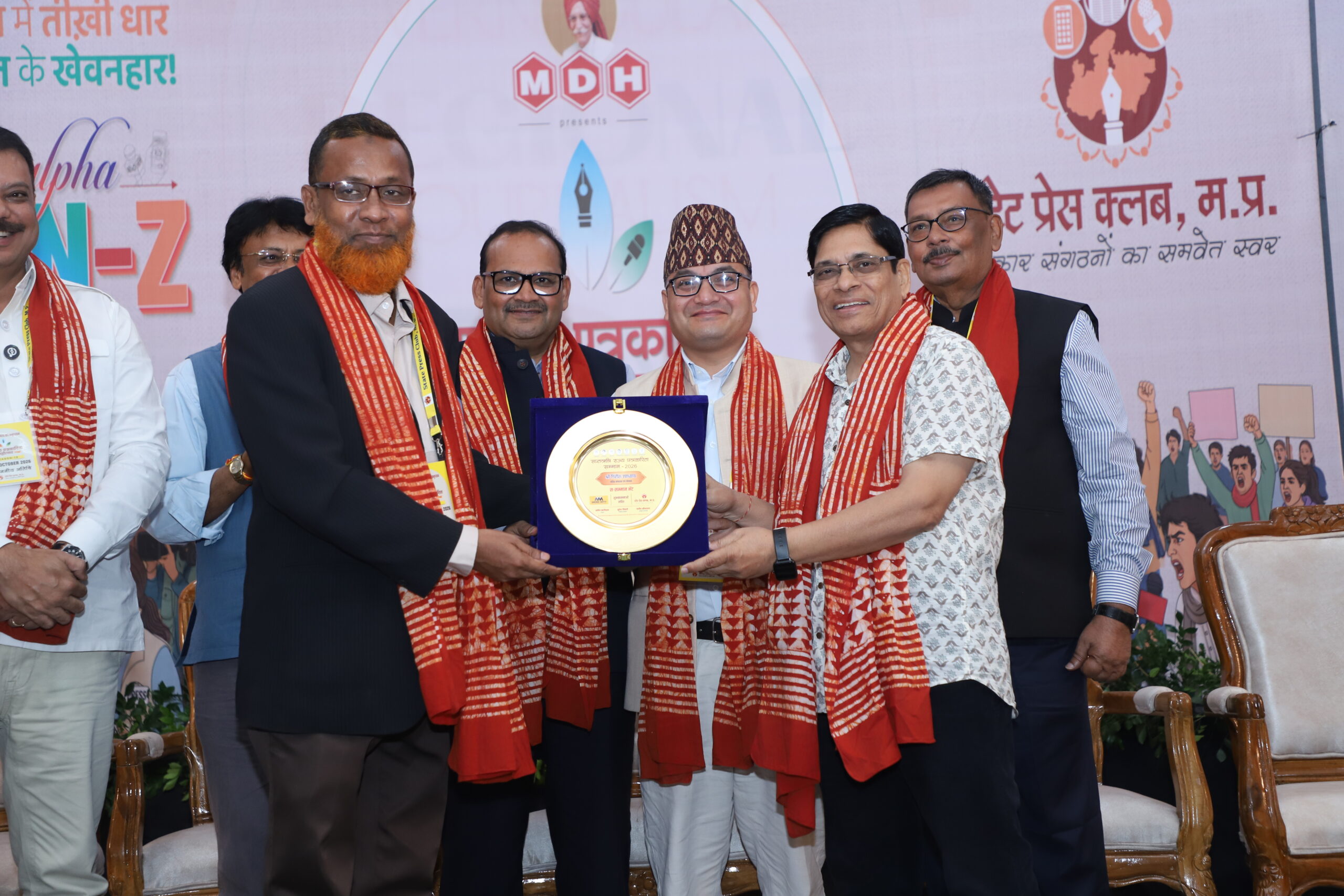 Saptarishi Awards Announced
A highlight of the festival is the presentation of honors recognizing excellence and lifelong contributions to journalism: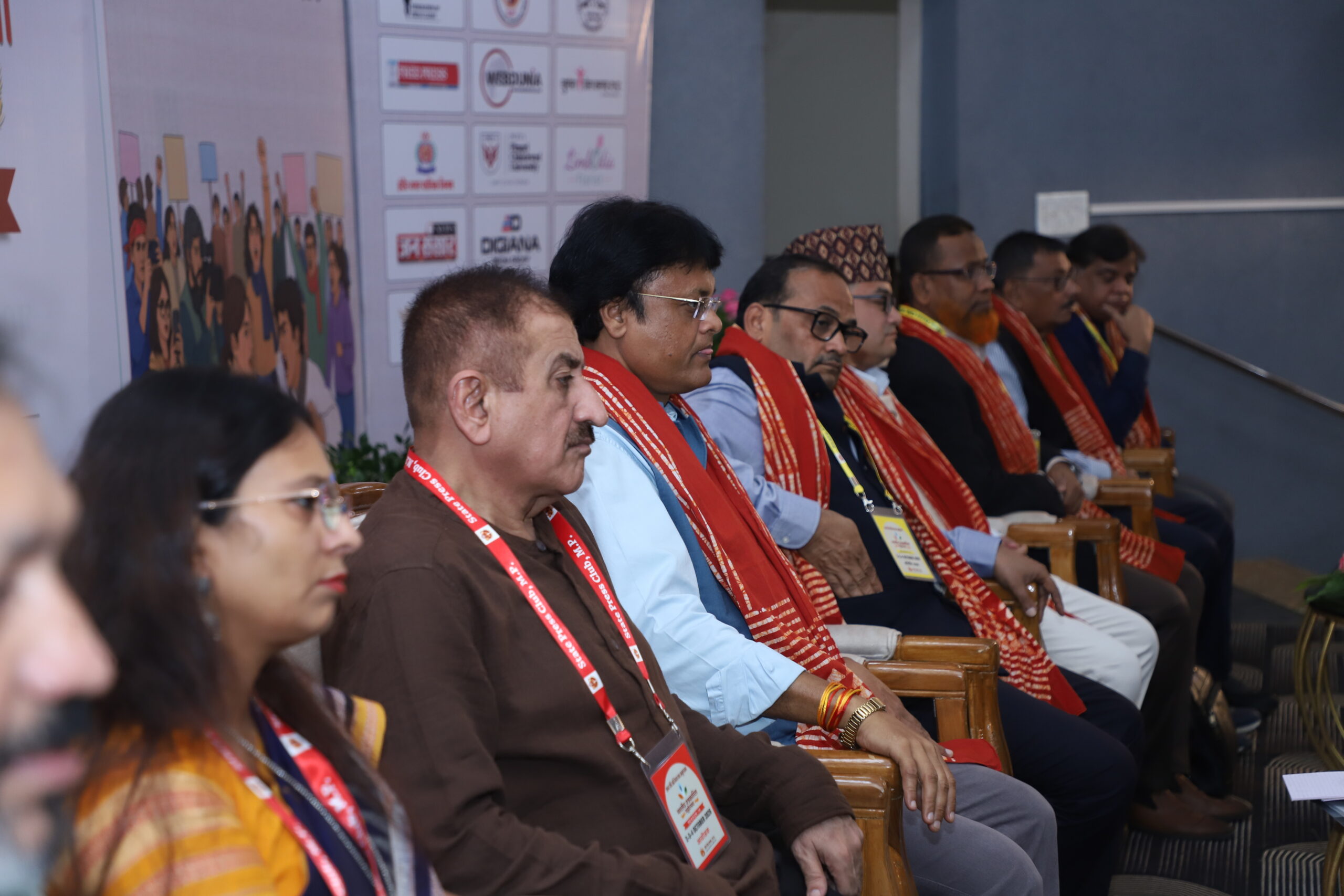 Saptarishi Lifetime Achievement Award:
73-year-old senior editor Devpriya Awasthi is being honored with this prestigious award, instituted in memory of the legendary poet and literary icon Late Naresh Mehta.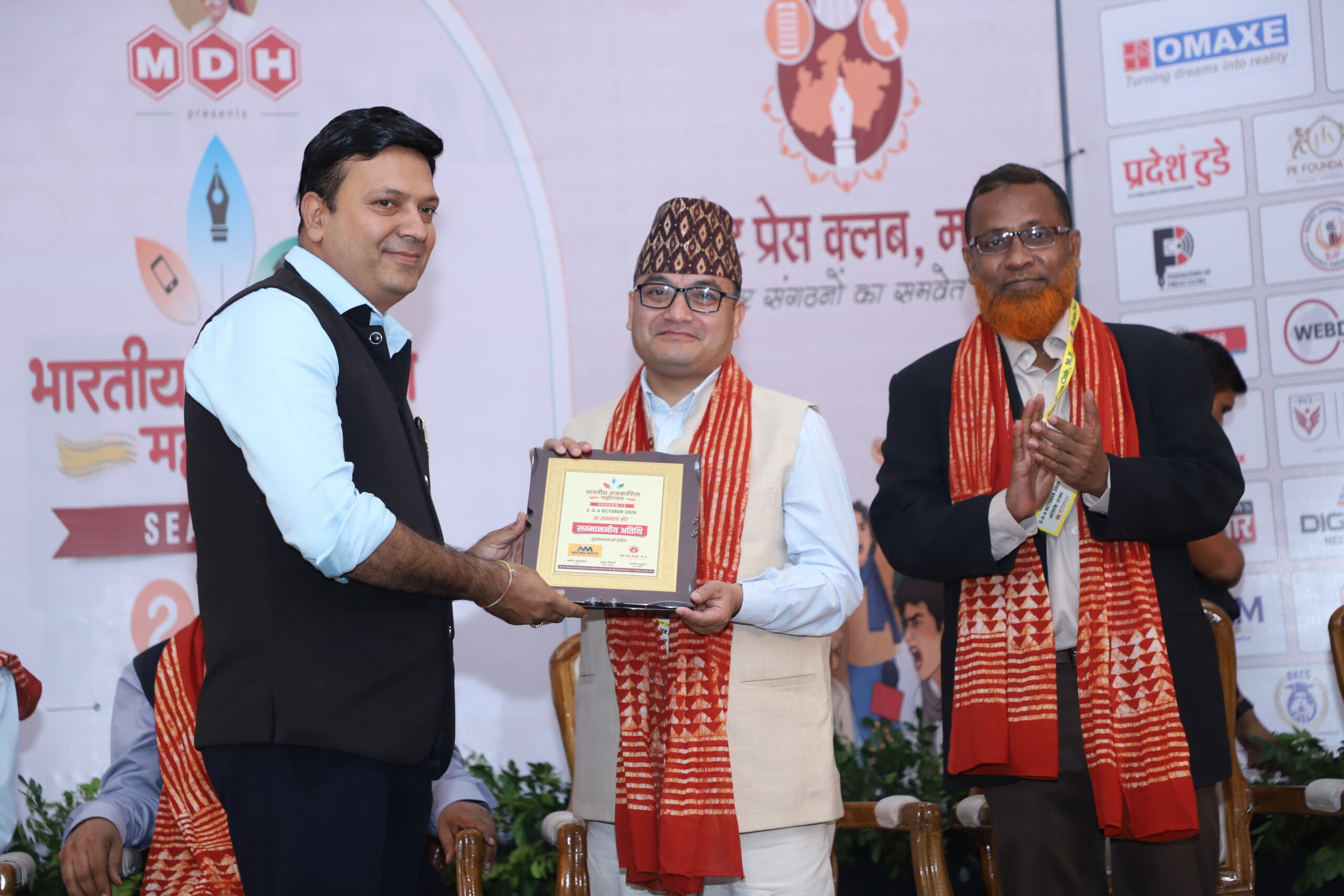 National Journalism Awardees:
Hardik Vikas Dave (Zee News), Tejashree Purandare (NDTV), Pankaj Wankhede (News India), Shubham Gautam (NDTV MP-CG), Preeta Upadhyay (Zee Media), Shikha Sharma (Magnon Group), Vaibhav Palnitkar (Dainik Bhaskar Group), Vishnukant Tiwari (BBC News Hindi), Vani Mishra (IBC-24), Himanshi Tiwari (India TV), and RJ Anadi Tiwari.
State Journalism Awardees: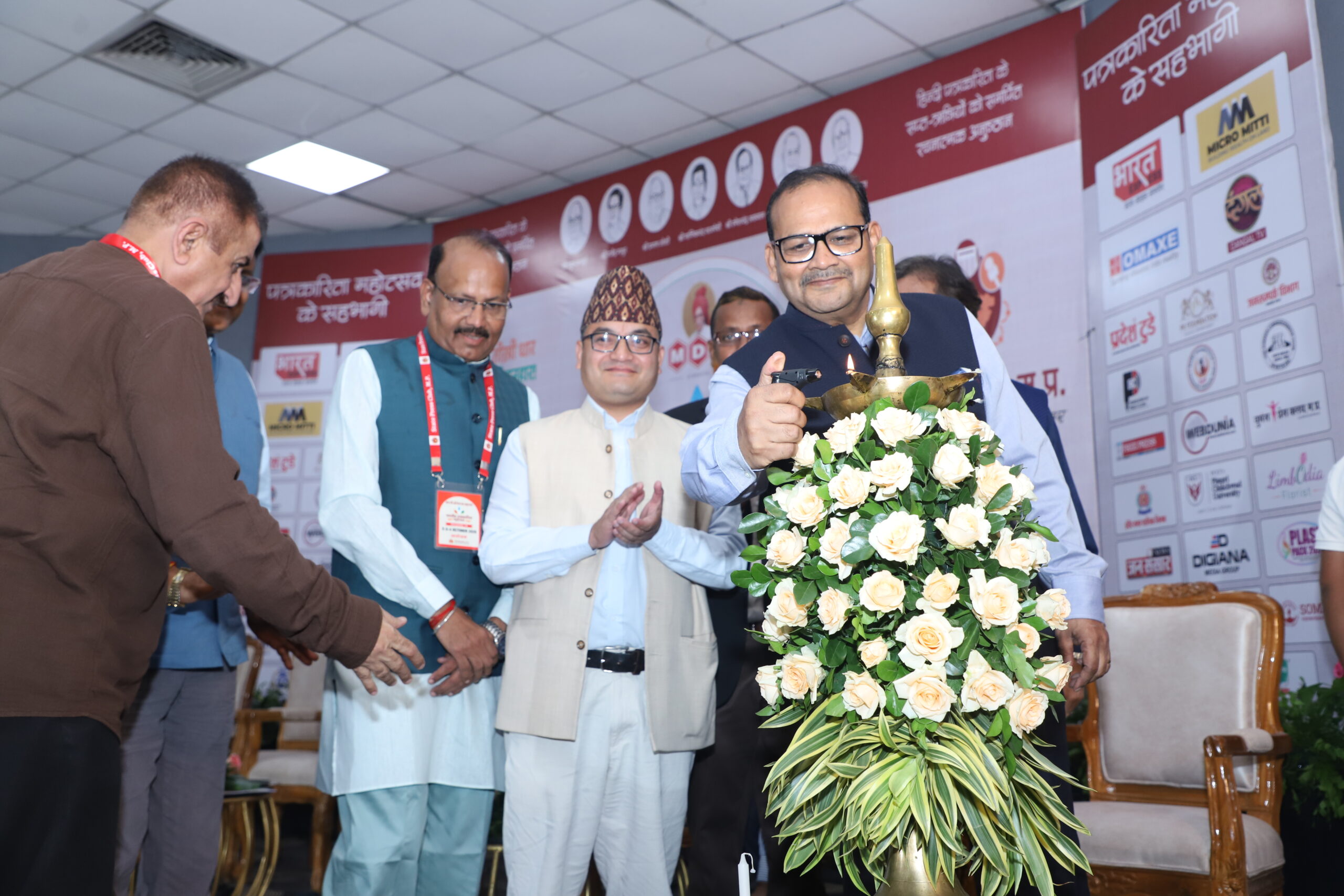 Girish Upadhyay, Prakash Bhatnagar (Anadi TV), Deshdeep Saxena (The Wildlife.com), Sharad Dwivedi (Bansal News), Sudhir Dixit (News18 MP-CG), Prabhu Pateriya (Swaraj Express SMBC), Shifali (ETV Bharat Digital), Shruti Tomar (Hindustan Times), Rajesh Sharma (Dainik Bhaskar Digital), Shashikant Trivedi, Bhavna Shukla (The Hitavada), and Pankaj Shukla (Subah-Savere).
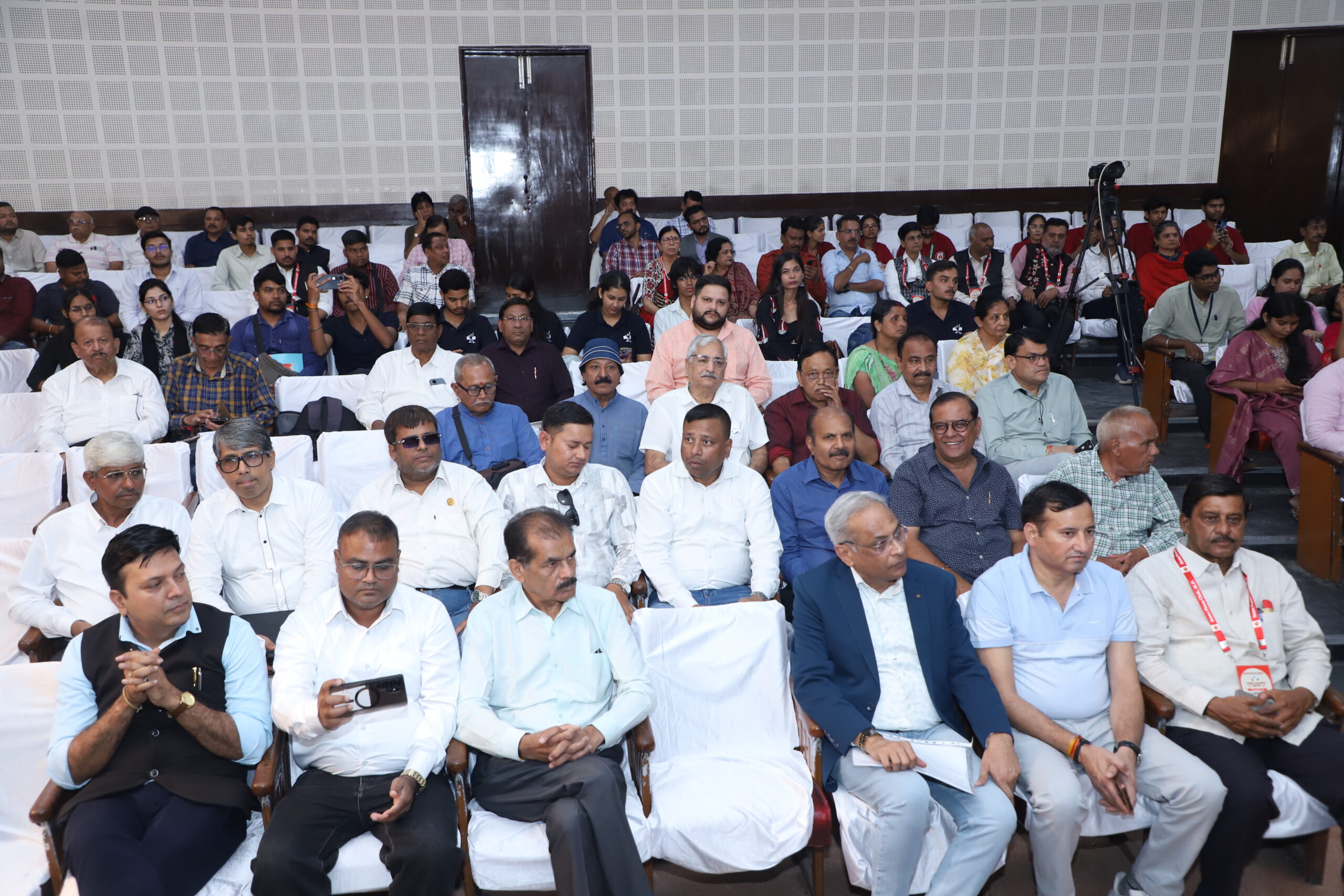 In three days, panel discussions, media summits, and interactive sessions have addressed the evolving landscape of Indian journalism and in the digital era.
Posted: September 27, 2026 by admin_raju Leave a Comment
SAARC Journalist Forum Expresses Solidarity with ICJ Declaration on Official Status of Professional Journalists
Kathmandu, September 27, 2026 — The SAARC Journalist Forum (SJF) has expressed its solidarity with the ICJ Declaration on the Official Status of Professional Journalists, an international initiative launched by the Intercontinental Connection of Journalists (ICJ) to strengthen recognition, protection and professional safeguards for journalists worldwide.
The ICJ Declaration responds to growing risks faced by journalists working in conflict zones, crisis areas, protests and other high-risk environments. It proposes a framework under which verified professional journalists would receive internationally recognized status and enhanced protection while carrying out legitimate journalistic duties.
The Declaration calls for professional journalists meeting defined standards of credentials, professional experience, ethical conduct and independent reporting to be eligible for recognition. It also proposes an international verification and accreditation mechanism, including a possible Global Registry of Verified Journalists under an independent international body.
Under the proposed framework, journalists could receive greater protection during armed conflicts, civil unrest and other dangerous situations, as well as improved access to public information and major international events. The Declaration also proposes mechanisms for emergency assistance, insurance and compensation in cases involving injury, detention or death.
The SAARC Journalist Forum welcomes the initiative as an important contribution to the international discussion on journalist safety, press freedom and professional recognition. SJF believes that journalists must be able to perform their public-interest responsibilities without intimidation, violence or unjustified interference, while maintaining the highest standards of accuracy, independence and professional ethics.
SJF also emphasizes that enhanced recognition and protection of journalists must go together with professional responsibility. The ICJ Declaration itself calls on recognized journalists to uphold truth, accuracy and fairness, respect human dignity and cultural diversity, reject corruption and manipulation, and remain accountable to professional and ethical standards.
The solidarity comes in the context of the formal strategic partnership between the ICJ Global Media Group and the SAARC Journalist Forum, established through a Memorandum of Understanding signed by SJF International President Raju Lama and ICJ Founder and CEO Saša Dobrijević. The partnership brings together journalists from South Asia and the wider international media community around cooperation, press freedom and journalist protection.
Raju Lama, International President of the SAARC Journalist Forum, said that international cooperation among journalists’ organizations is increasingly important as journalists face risks that cross national borders.
“SAARC Journalist Forum stands in solidarity with initiatives that seek stronger professional recognition, safety and dignity for journalists. The protection of journalists is essential to the public’s right to receive reliable information. At the same time, such protection must be accompanied by professional ethics, accountability and respect for the principles of independent journalism,” Lama said.
SJF said it looks forward to continued dialogue with ICJ and other international journalism organizations on practical mechanisms for journalist safety, professional accreditation, cross-border cooperation and the protection of media workers.
The Forum further encouraged journalists’ organizations, press associations, international institutions and governments to participate constructively in the global discussion surrounding the proposed ICJ Declaration. SAARC Journalist Forum reiterates its commitment to international solidarity among journalists and to the protection of press freedom, professional journalism and the safety of media workers across South Asia and beyond.
Posted: September 26, 2026 by admin_raju Leave a Comment
SAARC Journalist Forum Leaders Raju Lama and Md Abdur Rahman to Attend Bhartiya Patrakarita Mahotsav in Indore
Indore, India, September 26, 2026 — SAARC Journalist Forum International President Raju Lama and Secretary General Md Abdur Rahman are set to attend the 18th Bhartiya Patrakarita Mahotsav, scheduled to be held from October 2–4, 2026, at Jall Auditorium, Indore, Madhya Pradesh.
Organised under the theme “Celebration of the Identity and Dignity of Words”, the three-day journalism festival will bring together journalists, editors, media professionals and representatives of journalist organisations for discussions on the changing landscape of Indian journalism.
A major theme highlighted for the 18th edition is “Gen-Z Journalism”, focusing on how the younger generation is shaping journalism, news consumption and communication in the digital era. The programme also highlights questions surrounding the future of journalism, professional responsibility and the evolving role of the press.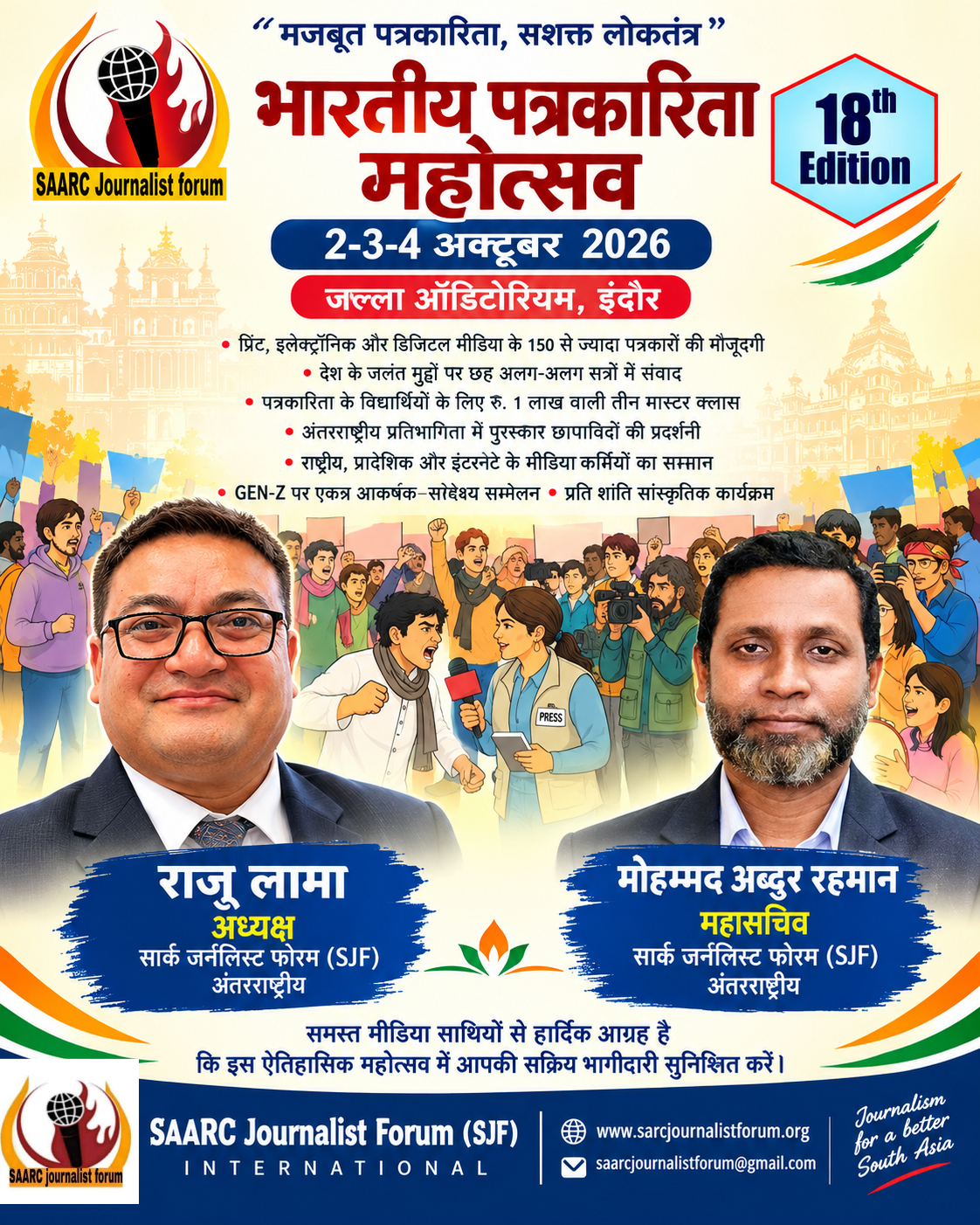 The participation of Raju Lama and Md Abdur Rahman will provide an international and South Asian perspective to discussions at the festival. Representing the SAARC Journalist Forum, they are expected to engage with journalists and media organisations from India and other parts of the region and discuss issues concerning press freedom, journalist safety, regional media cooperation and the future of journalism in South Asia.
The SAARC Journalist Forum has been working to strengthen cooperation among journalists and media organisations across the South Asian region. Lama’s participation also comes in the context of his wider engagement with international journalism organisations and media platforms.
The Bhartiya Patrakarita Mahotsav Season 18 is scheduled for October 2, 3 and 4, 2026, in Indore. The State Press Club, Madhya Pradesh presents the festival as a platform bringing together journalist organisations.
Posted: September 23, 2026 by admin_raju Leave a Comment
International Media Summit – 2026 Held in Jamalpur, Bihar
Jamalpur, Munger, Bihar (India), September 22, 2026 – The International Media Summit-2026 (Global Media Summit-2026) was held in Jamalpur, Munger district of India, with the objective of strengthening dialogue, cooperation and experience-sharing among journalists and media professionals across South Asia.
Organized by the All India Journalists Union (AIJU), India, the summit was held at Siddhi Vinayak Marriage Hall in Jamalpur. Indian Rajya Sabha Member of Parliament Dr. Bhim Singh attended the event as the chief guest, while Munger MLA Pranav Kumar was also present as a special guest.
The summit was chaired by Ranjit Samrat, National President of the All India Journalists Union, India. Journalists and media professionals from Nepal, India, Bhutan, Bangladesh and Sri Lanka participated in the event, including Raju Lama, President of the SAARC Journalists Forum International, and Secretary General Abdur Rahman.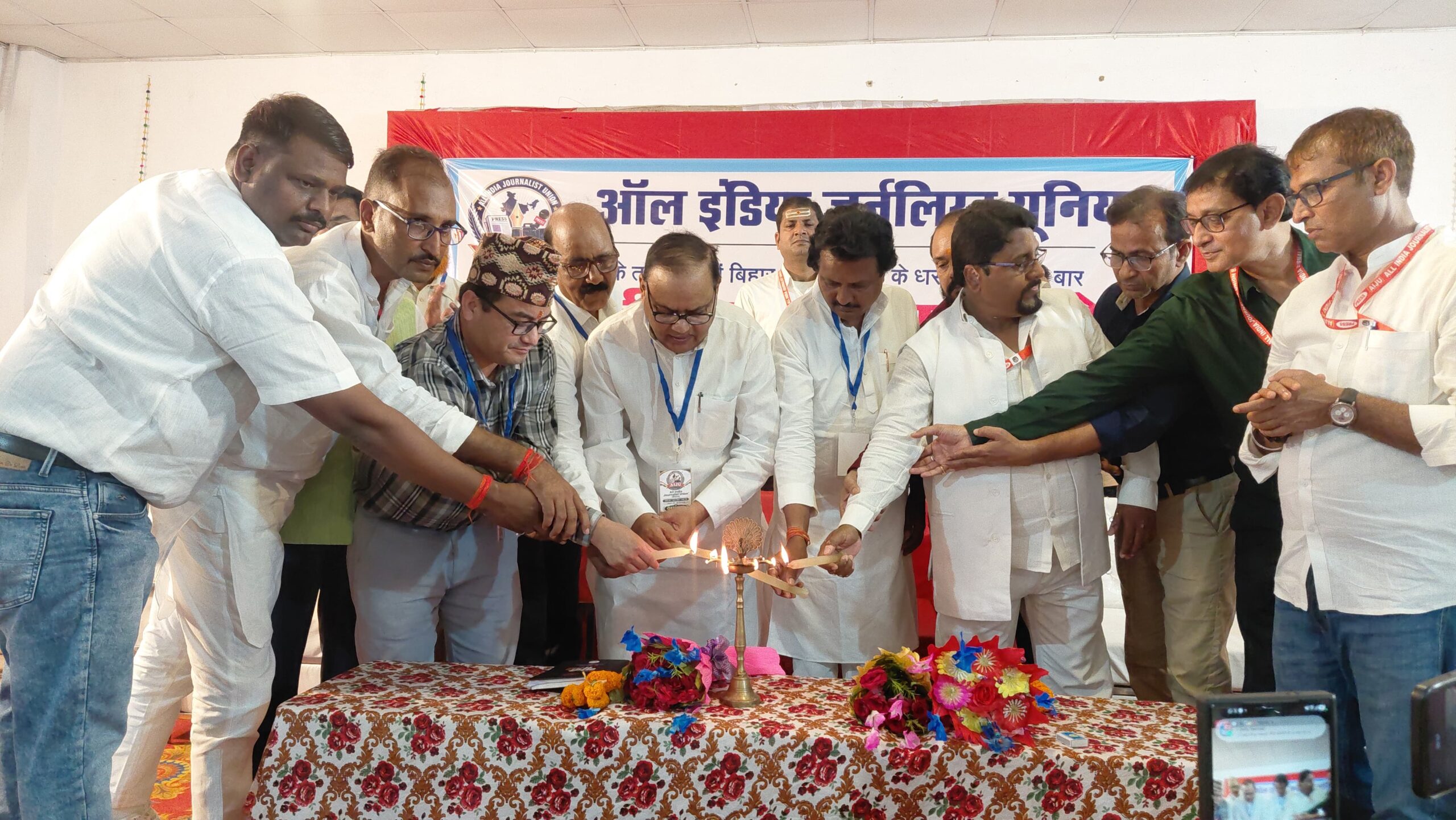 Addressing the gathering, chief guest Dr. Bhim Singh said journalism is an important medium connecting society with information, ideas and facts. He emphasized that international cooperation among media professionals can contribute to making journalism more responsible and effective.
Dr. Singh said, “Journalism is an important pillar of democracy. Although our borders are different, the responsibility and objective of journalists is to provide society with truth, facts and accurate information. Dialogue and cooperation among journalists in South Asia can make an important contribution to strengthening the journalism sector.”
Similarly, SAARC Journalists Forum International President Raju Lama stressed the need for regular dialogue and cooperation among journalists from South Asian countries. He said international conferences such as the Jamalpur summit provide an opportunity for journalists to understand each other’s experiences and collaborate on common issues. Lama said, “Relations among South Asian journalists should not be limited to the exchange of news. Cooperation is also necessary on issues such as journalists’ rights, professional safety, press freedom and common challenges facing the media sector. The conference in Jamalpur has created a new environment for such dialogue.”
The summit was attended by SAARC Journalists Forum Nepal Chapter Convener Rudra Subedi, Co-Convener Md. Arif Ansari, Bihar Chapter President Dr. Shashi Bhushan Kumar, Madhesh Chapter Coordinator Md. Sadab Malik, and members Ramesh Chandra Kumal, Azmat Ali, Sushil Kumar Khadka, Abhilash Gupta, Pawan Prasad Sah and Arun Kalwar, among other journalists and media professionals from different countries.
Participants discussed contemporary issues in journalism and the media sector and exchanged experiences from their respective countries and regions. Discussions focused on challenges facing journalism, developments in communication technology, journalists’ professional safety, international cooperation, and strengthening relations among South Asian media professionals.
The organizers said the first international journalism summit held in Jamalpur has created an important foundation for further strengthening mutual relations, dialogue and cooperation among journalists and media professionals in South Asia.
Participating journalists said the summit brought media professionals from different countries together on a common platform and provided an opportunity to exchange views on shared issues in journalism. They expressed the expectation that the conference would pave the way for more effective cooperation and regular dialogue among South Asian media professionals in the days ahead.
Posted: September 18, 2026 by admin_raju Leave a Comment
SAARC Journalist Forum Leaders to Attend International Patrakar Mahasammelan in Munger, Bihar
Munger/Jamalpur, Bihar | September 18, 2026 — Senior leaders of the SAARC Journalist Forum (SJF) will participate in the International Patrakar Mahasammelan scheduled to be held on September 20, 2026, in Jamalpur/Munger, Bihar, India.
According to the event announcement, Raju Lama, International President of the SAARC Journalist Forum, and Md. Abdur Rahman, Secretary General of the SAARC Journalist Forum have been invited as Special Guests at the international journalists’ gathering.
The programme is being organized by the All India Journalist Union (Bharat) under the leadership of its National President Ranjit Samrat, in collaboration with the SAARC Journalist Forum.
The day-long programme is scheduled from 10:00 AM to 6:00 PM, with sessions covering the inauguration and introduction, media motivational speeches, guest speeches and an award ceremony, followed by a concluding session.
Platform for South Asian media cooperation
The participation of the SJF leadership is expected to provide an opportunity for journalists and media organizations from India and South Asia to exchange views on contemporary challenges facing journalism, professional cooperation and the role of media in strengthening regional understanding.
Raju Lama has in recent months represented SJF in a number of international journalism and multilateral engagements, including activities connected with the United Nations and international media organizations. SJF has also been pursuing cooperation with journalism organizations beyond South Asia, with a focus on professional exchanges, press freedom and cross-border media collaboration.
For Md. Abdur Rahman, the Munger gathering will add to his recent regional journalism engagements. His participation in various activities involving journalists from Bangladesh, Nepal and other South Asian countries, included discussions on regional media cooperation and professional dialogue.
The International Patrakar Mahasammelan is therefore expected to bring together journalists and media representatives around a common platform for discussion, recognition and networking. The participation of the SAARC Journalist Forum leadership also highlights the growing emphasis on regional journalist-to-journalist cooperation across South Asia.
Posted: September 5, 2026 by admin_raju Leave a Comment
SAARC Journalists Forum Strongly Condemns Brutal Police Assault on Female Journalists in Delhi
Kathmandu, September 5, 2026 – SAARC Journalists Forum (SJF) has issued a press release expressing deep outrage and unequivocal condemnation regarding the recent physical assault and inhumane treatment inflicted upon journalists Shaheen Khan and Nafeesa Khan by Delhi police.
According to reports, Shaheen Khan, a journalist working for ‘4PM’, was violently dragged by her hair, slammed to the ground, and subjected to physical assault including kicks and punches while attempting to ask a question to the Chief Minister of Delhi during her professional duties. The SJF described this act as a severe blow to press freedom and a grave violation of fundamental human rights across the South Asian region.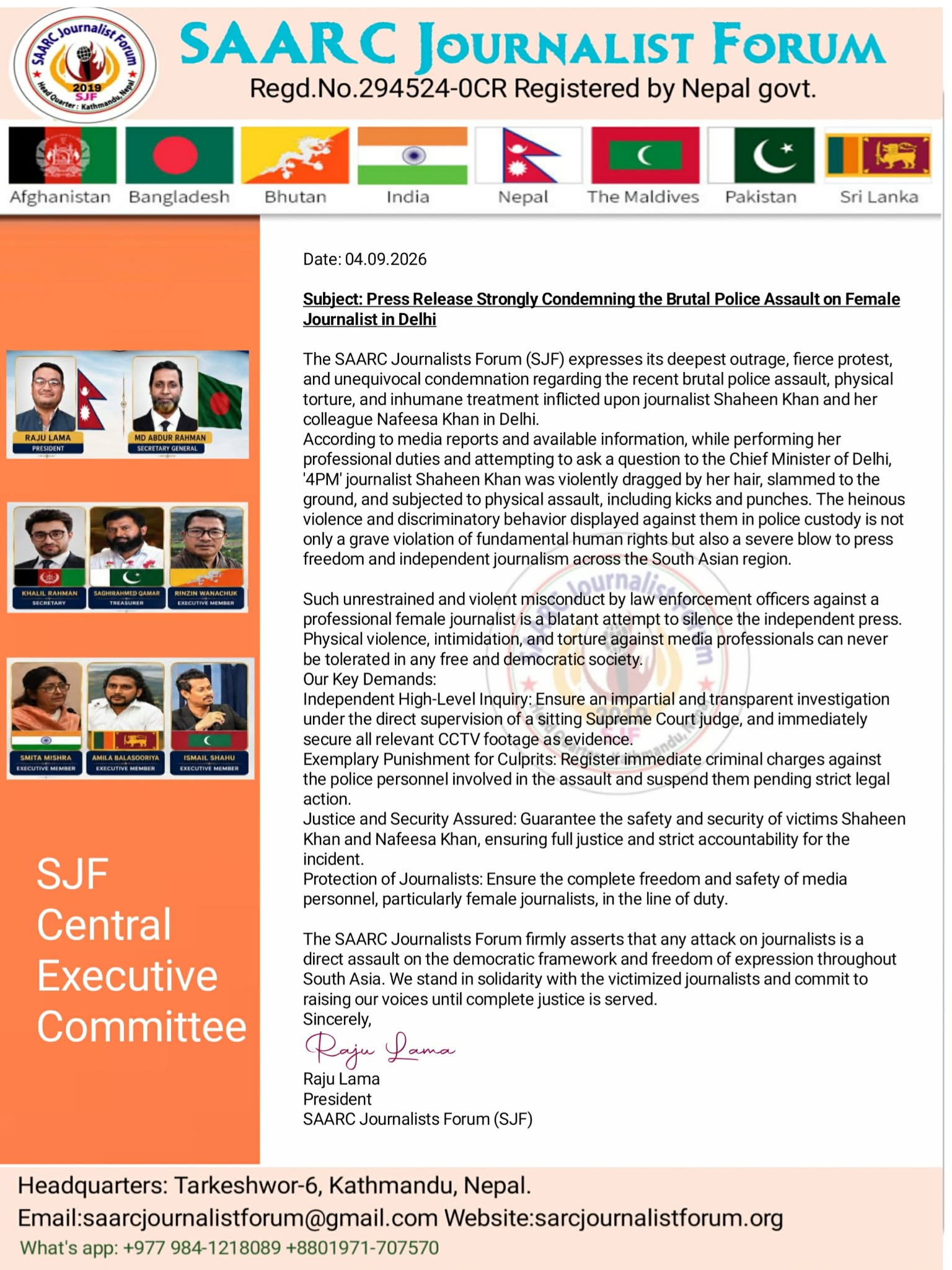 In a press statement signed by SJF President Raju Lama, the forum put forward four key demands to the authorities:
1. Independent High-Level Inquiry:Conduct an impartial and transparent investigation under the direct supervision of a sitting Supreme Court judge, while securing all relevant CCTV footage as evidence.
2. Exemplary Punishment for Culprits:Register immediate criminal charges against the police personnel involved in the assault and suspend them pending strict legal action.
3. Justice and Security Assured:Guarantee the full safety and security of the victims, Shaheen Khan and Nafeesa Khan, ensuring complete accountability.
4. Protection of Journalists:Ensure total freedom and safety for media professionals, particularly female journalists, while performing their duties in the line of work.
The SAARC Journalists Forum firmly asserted that any attack on journalists represents a direct assault on the democratic framework and freedom of expression throughout South Asia, pledging its full solidarity with the victimized journalists until complete justice is served.
Last Updated: August 25, 2026 by admin_raju Leave a Comment
SAARC Journalist Forum President Raju Lama’s Activities in the United States: April 10–August 20, 2026
New York/Kathmandu, August 20, 2026 – International President of the SAARC Journalist Forum (SJF), Raju Lama, undertook a wide range of professional, diplomatic and journalistic activities in the United States from April 10 to August 20, 2026, strengthening the voice of South Asian journalists and expanding SJF’s engagement with international media, diplomatic and multilateral institutions.
During his stay in the United States, Lama focused on promoting press freedom, journalists’ rights, international media cooperation, South Asian issues and the role of journalism in strengthening democracy and regional cooperation.
Engagement with the United Nations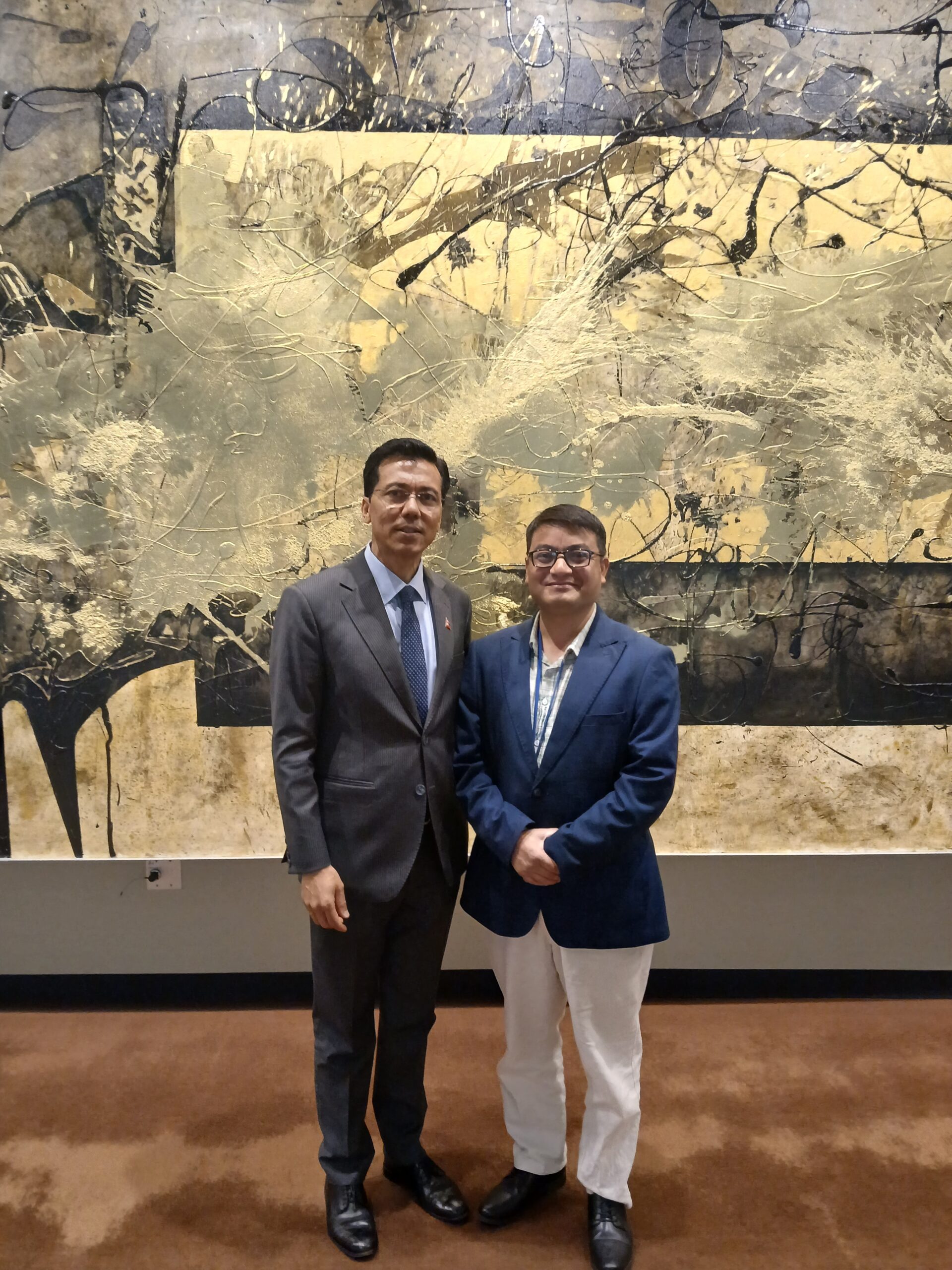 One of the major areas of Lama’s activities in the United States was his engagement with the United Nations and international policy forums in New York.
He attended the 25th Session of the Committee of Experts on Public Administration (CEPA) at the United Nations Headquarters in New York from April 13–17, 2026. The session provided an opportunity to follow discussions on public administration, governance, sustainable development and international cooperation.
Lama also participated in the ECOSOC Forum on Financing for Development Follow-up (FfD Forum) and the SDG Investment Fair, held in New York from April 20–24, 2026. Through these engagements, he followed international discussions concerning sustainable development, financing, global cooperation and the priorities of developing countries and the Global South.
During his UN-related engagements, Lama also maintained contact with diplomats, international officials, journalists and representatives of civil society organizations, promoting greater recognition of the perspectives and concerns of South Asian countries.
Engagement with International Journalism Organizations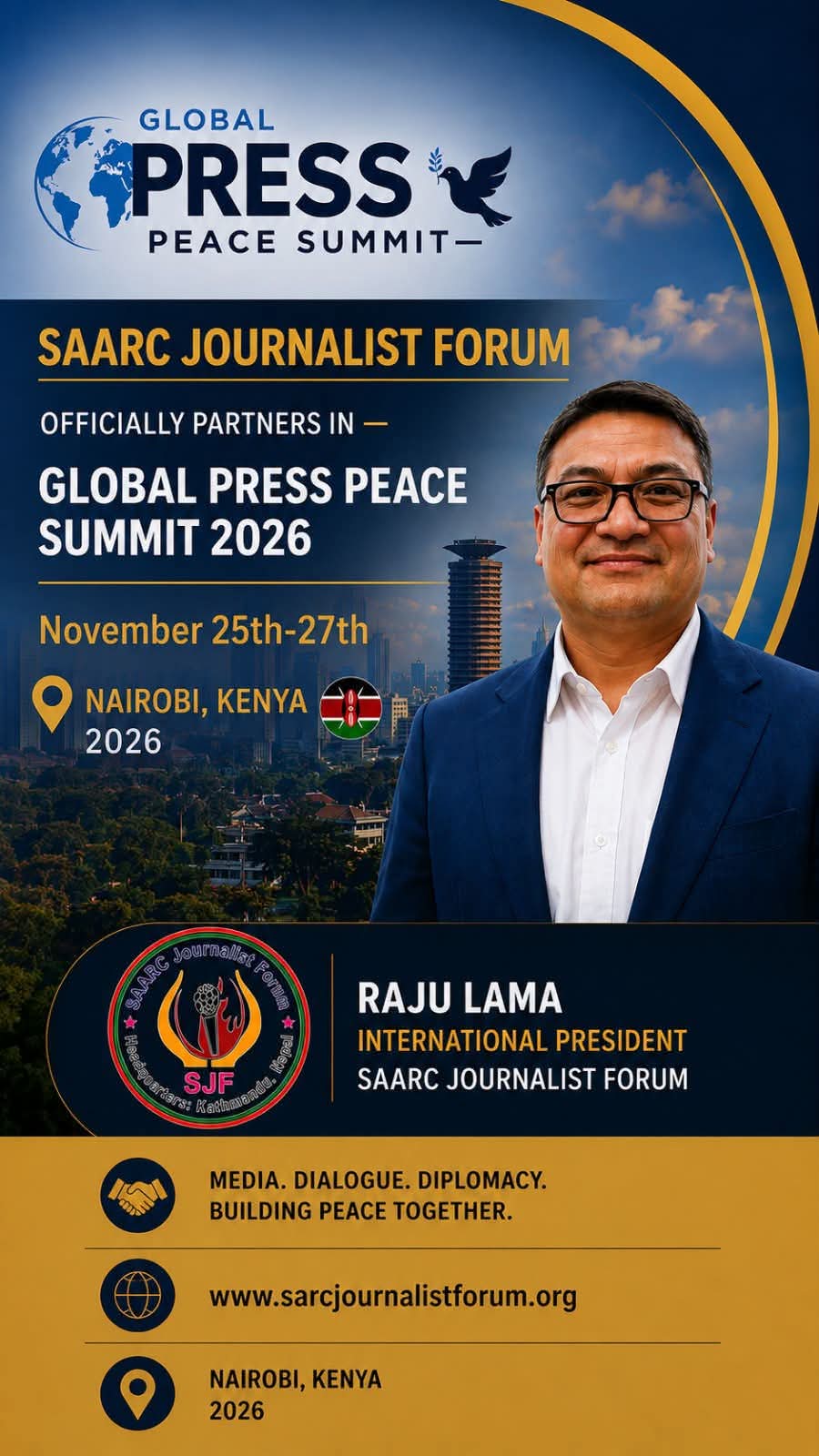 As President of the SAARC Journalist Forum, Lama also expanded his engagement with international journalism organizations and foreign correspondents in the United States.
He held discussions with Ian Williams, President of the Foreign Press Association of the United States, focusing on the changing environment for foreign journalists working in the United States and recent developments concerning journalists’ visas and media access.
The discussion highlighted the importance of protecting the professional rights of foreign correspondents and maintaining an open environment for international journalism.
Lama also explored opportunities for cooperation between SJF and international journalist organizations, with the objective of developing greater exchanges, professional training, networking and solidarity among journalists from South Asia and other regions.
Advocacy for Press Freedom and Journalists’ Rights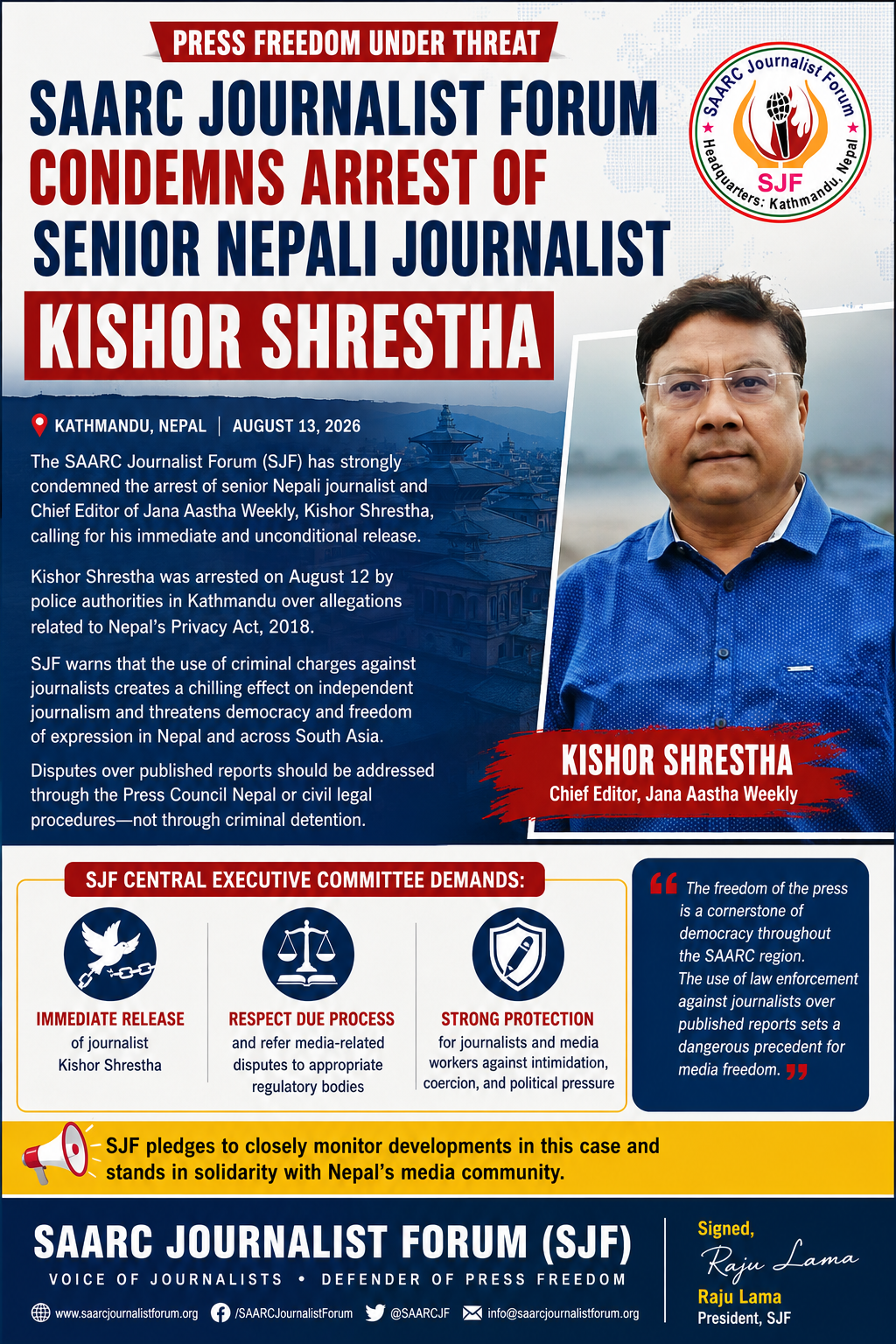
Press freedom and journalists’ safety remained central to Lama’s activities throughout his period in the United States.
As International President of SJF, he continued to advocate for the protection of journalists, freedom of expression and an independent media environment across South Asia.
SJF under Lama’s leadership also closely followed developments affecting journalists in Nepal and other South Asian countries, including cases involving arrests, restrictions and threats against members of the media.
The organization’s advocacy emphasized that journalists must be able to perform their professional responsibilities without intimidation, political pressure or unnecessary legal restrictions.
Representation of South Asian Journalism in the United States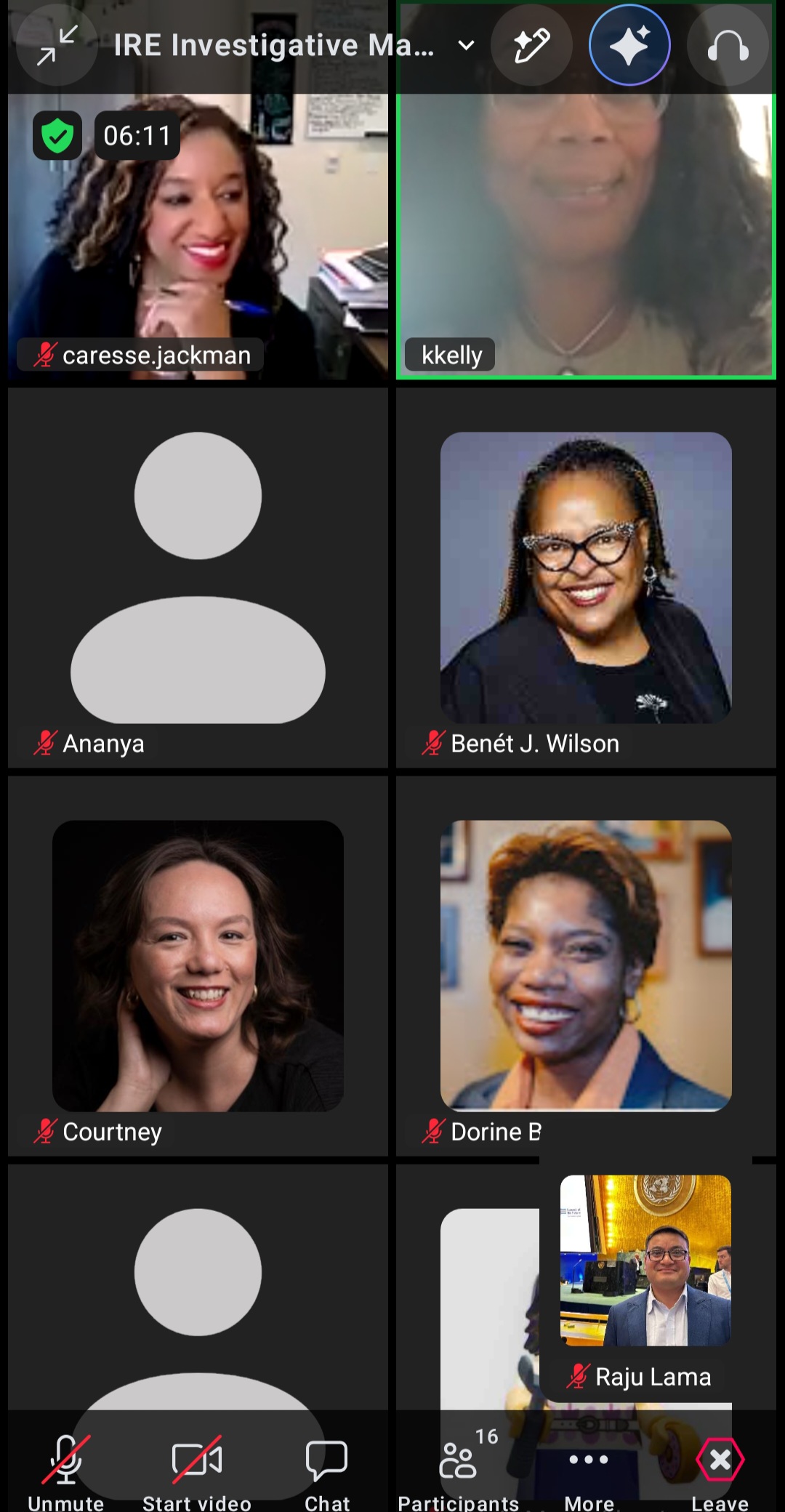 Lama used his presence in the United States to promote greater international understanding of South Asian journalism and the challenges facing journalists in the region.
Through meetings, professional networking and participation in international events, he emphasized the need for stronger cooperation between journalists from South Asia, the United States and the wider Global South.
He also promoted the concept of journalism as a bridge between societies, arguing that professional media cooperation can contribute to peace, dialogue, democratic values and regional understanding.
Engagement with Global South Issues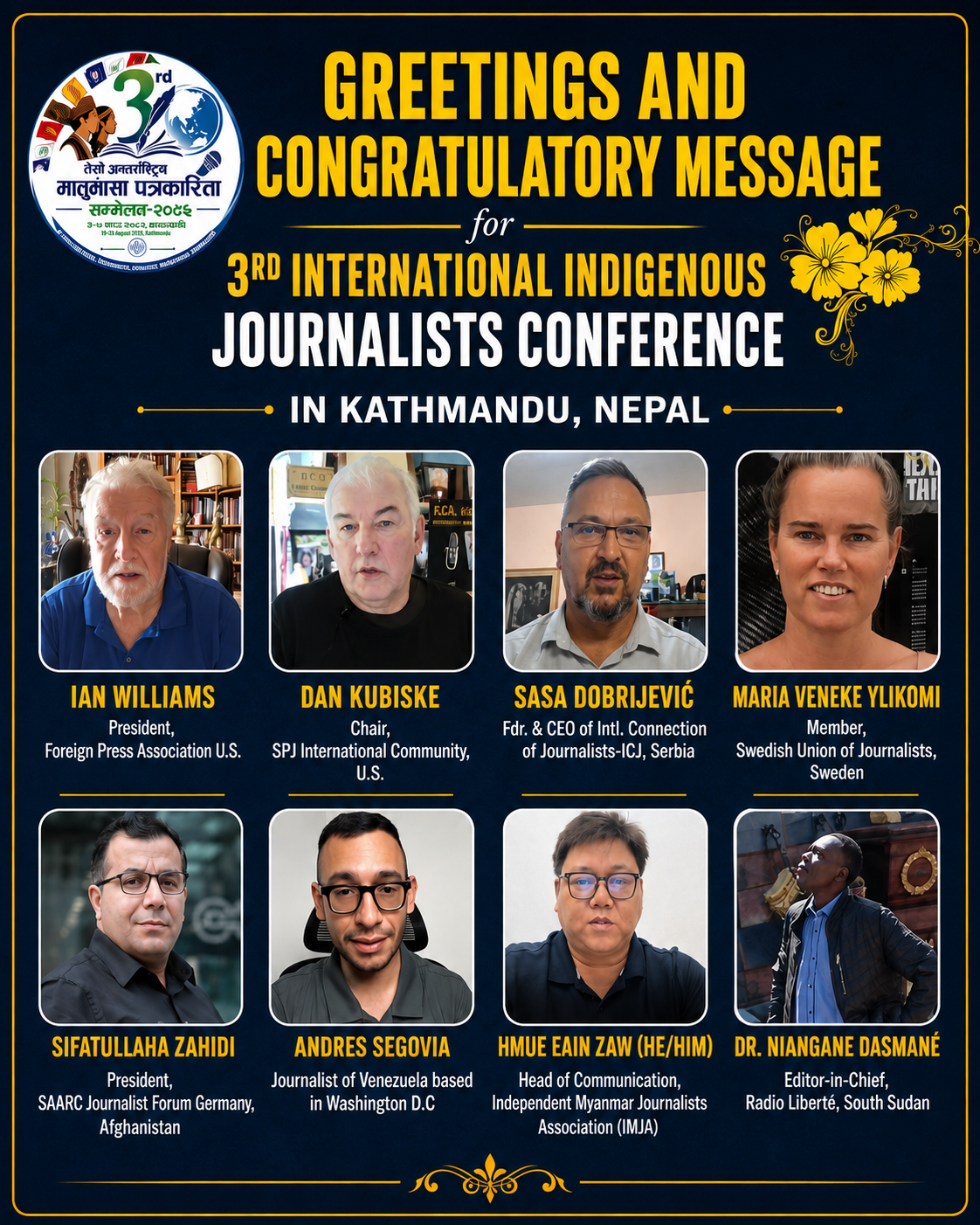 His participation in UN and ECOSOC-related programs provided an opportunity to follow global discussions on development, financing, governance and international cooperation from a South Asian perspective.
As President of SJF, Lama emphasized that international media discussions should provide greater space to the voices of journalists and communities from developing countries.
He advocated for stronger South-South media cooperation and greater representation of Global South perspectives in international journalism.
International Media and Professional Outreach
During his stay, Lama also continued strengthening the international profile of the SAARC Journalist Forum, which brings together journalists and media professionals from the South Asian region.
He worked toward developing relationships with international journalists, media organizations and professional networks in the United States, with the objective of creating future opportunities for:
* International journalist exchanges
* Professional training and capacity building
* Joint media programs
* Cross-border reporting
* Press freedom advocacy
* South Asian and Global South journalism cooperation
* International conferences and professional forums
These efforts are aimed at making SJF a stronger platform for regional and international cooperation among journalists.
Focus on U.S.–South Asia Media Relations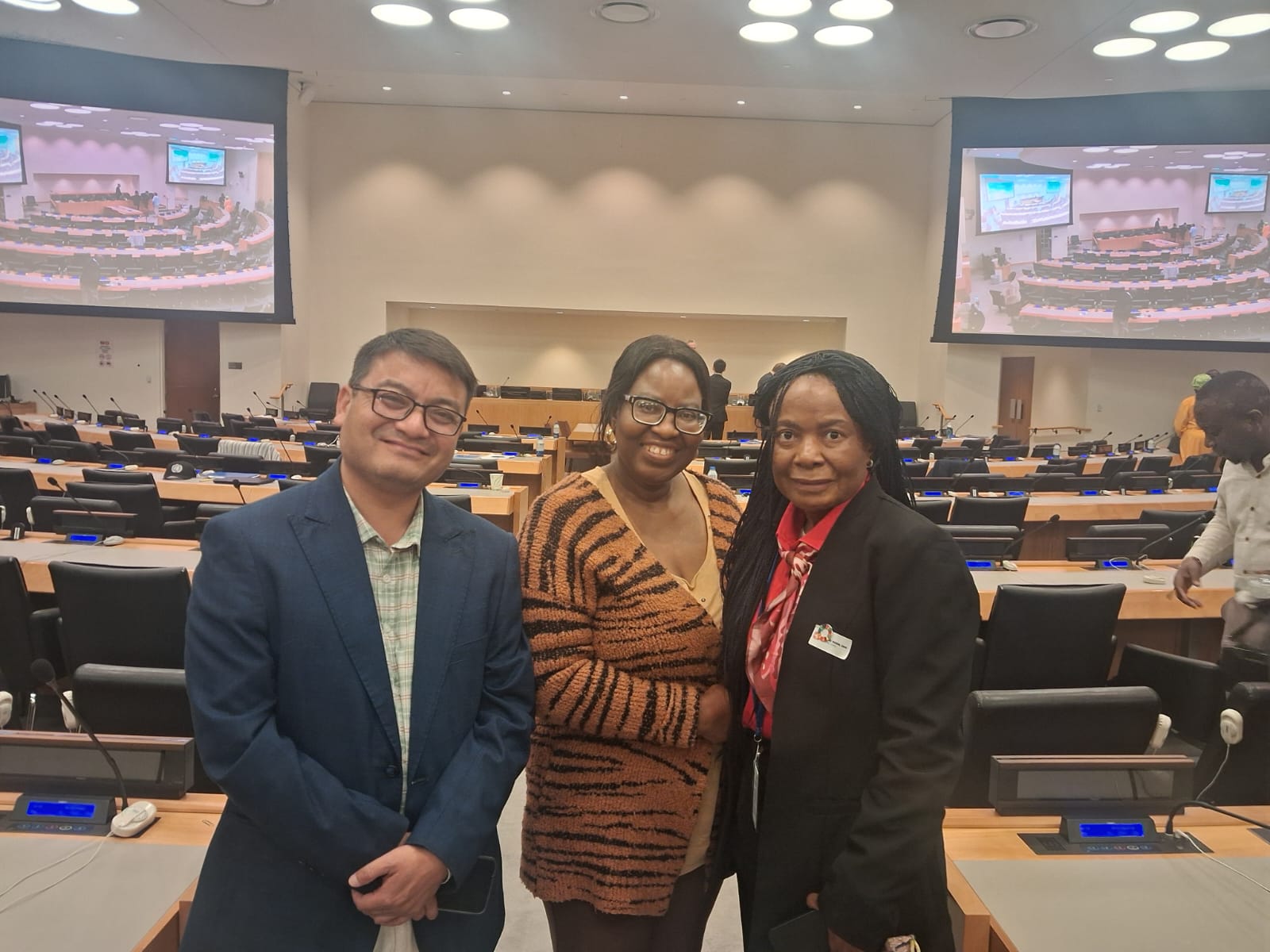 Lama also emphasized the importance of stronger media relations between the United States and South Asia.
He highlighted the significant role of journalists in improving public understanding between the two regions and encouraged greater opportunities for South Asian journalists to participate in international media programs, conferences and professional exchanges in the United States.
His activities also reflected SJF’s broader objective of connecting journalists across geographical and political boundaries while maintaining professional independence and journalistic ethics.
International Conferences and Journalistic Networking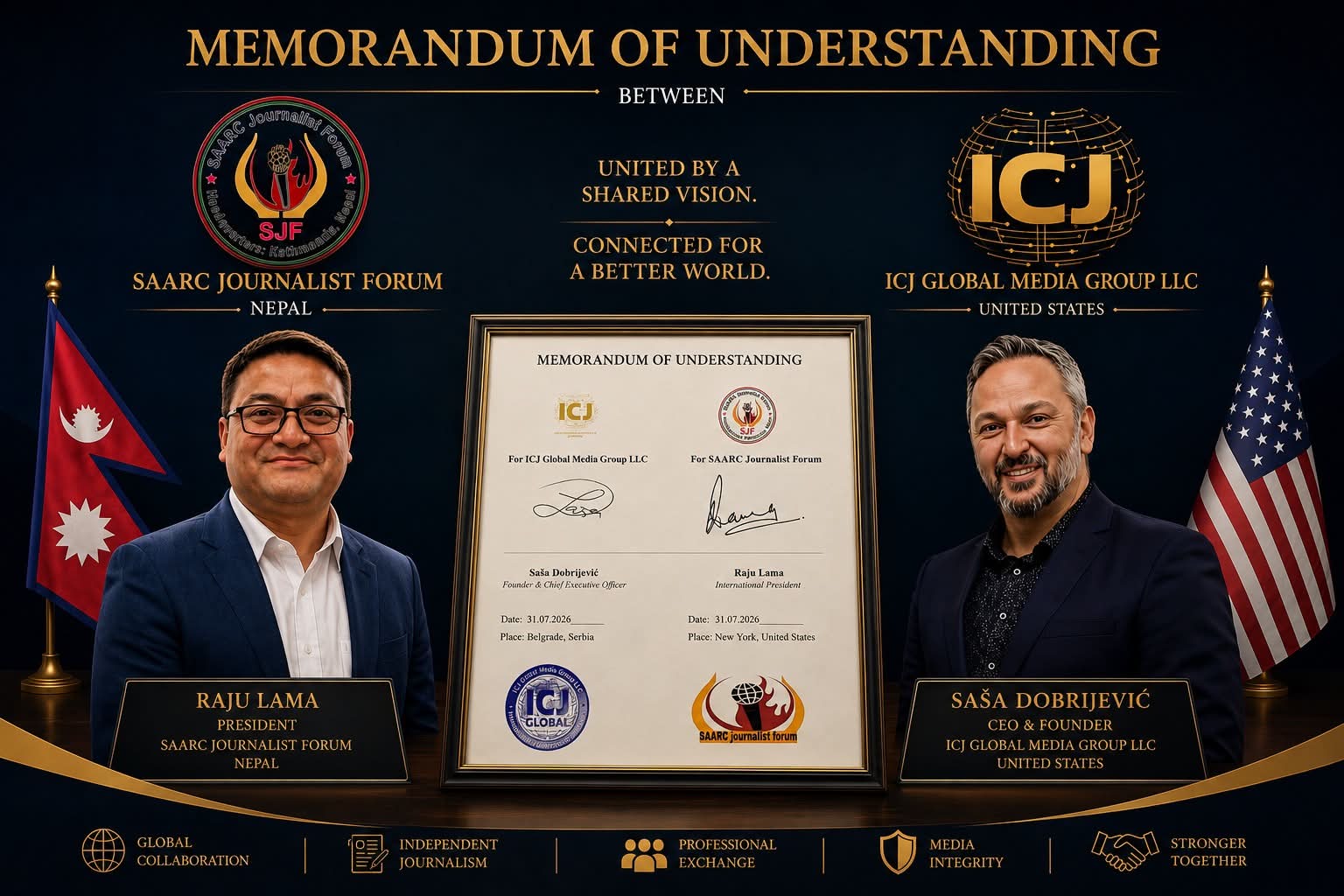 Throughout the April–August period, Lama maintained professional contacts with journalists, media leaders, diplomats, academics and representatives of international organizations.
He also pursued opportunities for SJF participation in international conferences and journalism forums, including initiatives connected with indigenous journalism, international press freedom and Global South media cooperation.
These activities contributed to expanding the international network of SJF and strengthening its position as a regional platform representing journalists from South Asia.
SJF’s International Solidarity During this period, SJF continued expressing solidarity with journalists and media organizations facing professional, legal or political challenges.
Under Lama’s leadership, the organization maintained its position that attacks on journalists, arbitrary detention, threats to media freedom and restrictions on independent journalism should be addressed through professional solidarity and international advocacy.
SJF also continued issuing messages of solidarity and concern on developments affecting journalists in South Asia.
Building International Partnerships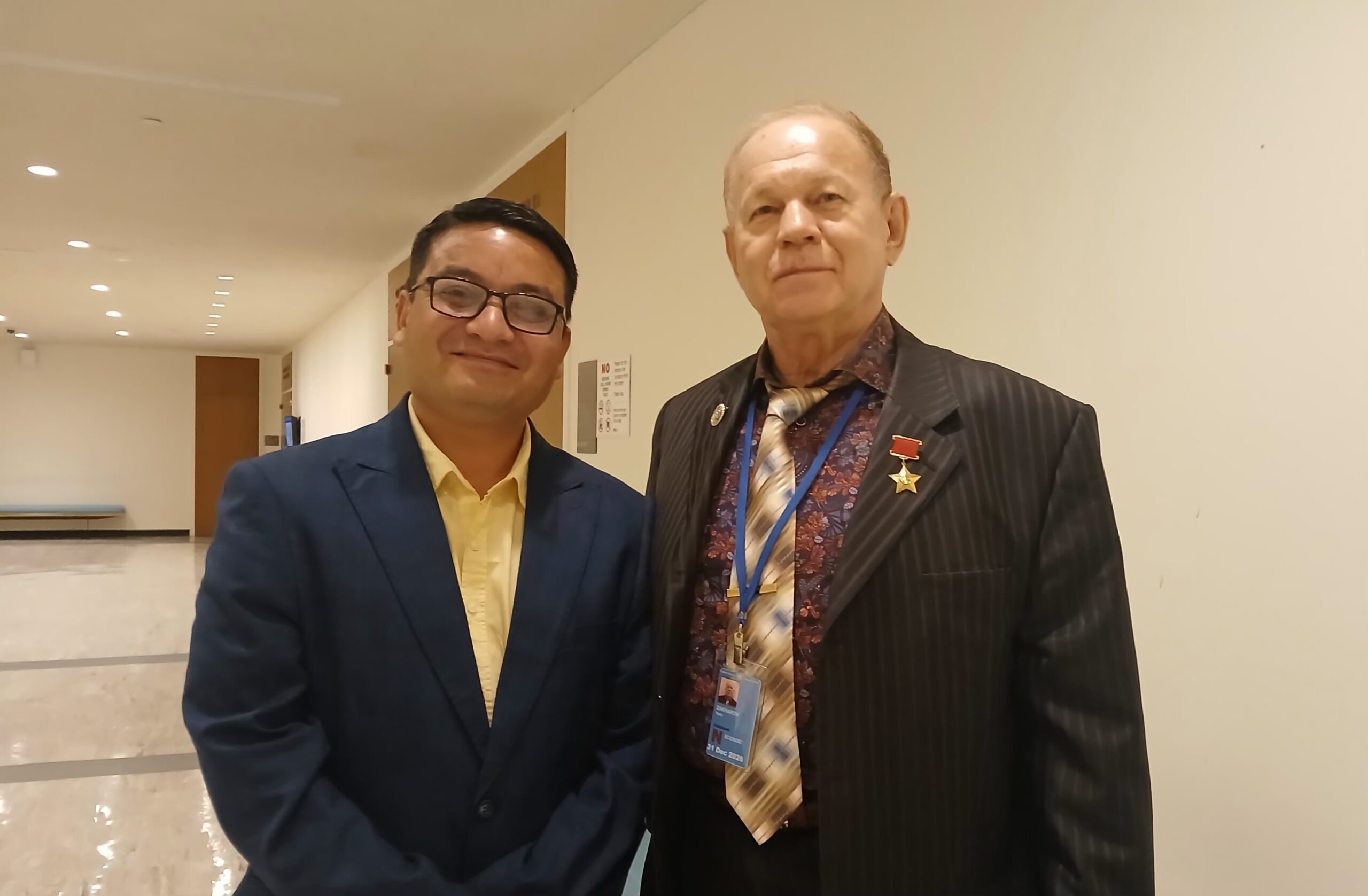 Lama’s activities in the United States also focused on identifying opportunities for institutional partnerships between SJF and international journalism organizations.
Potential areas of cooperation included journalist training, professional exchanges, conferences, research, digital journalism, press freedom initiatives and collaboration between regional journalist organizations.
The initiative reflects Lama’s effort to transform SJF from a primarily regional network into a stronger international platform for cooperation among journalists.
Strengthening the International Profile of SJF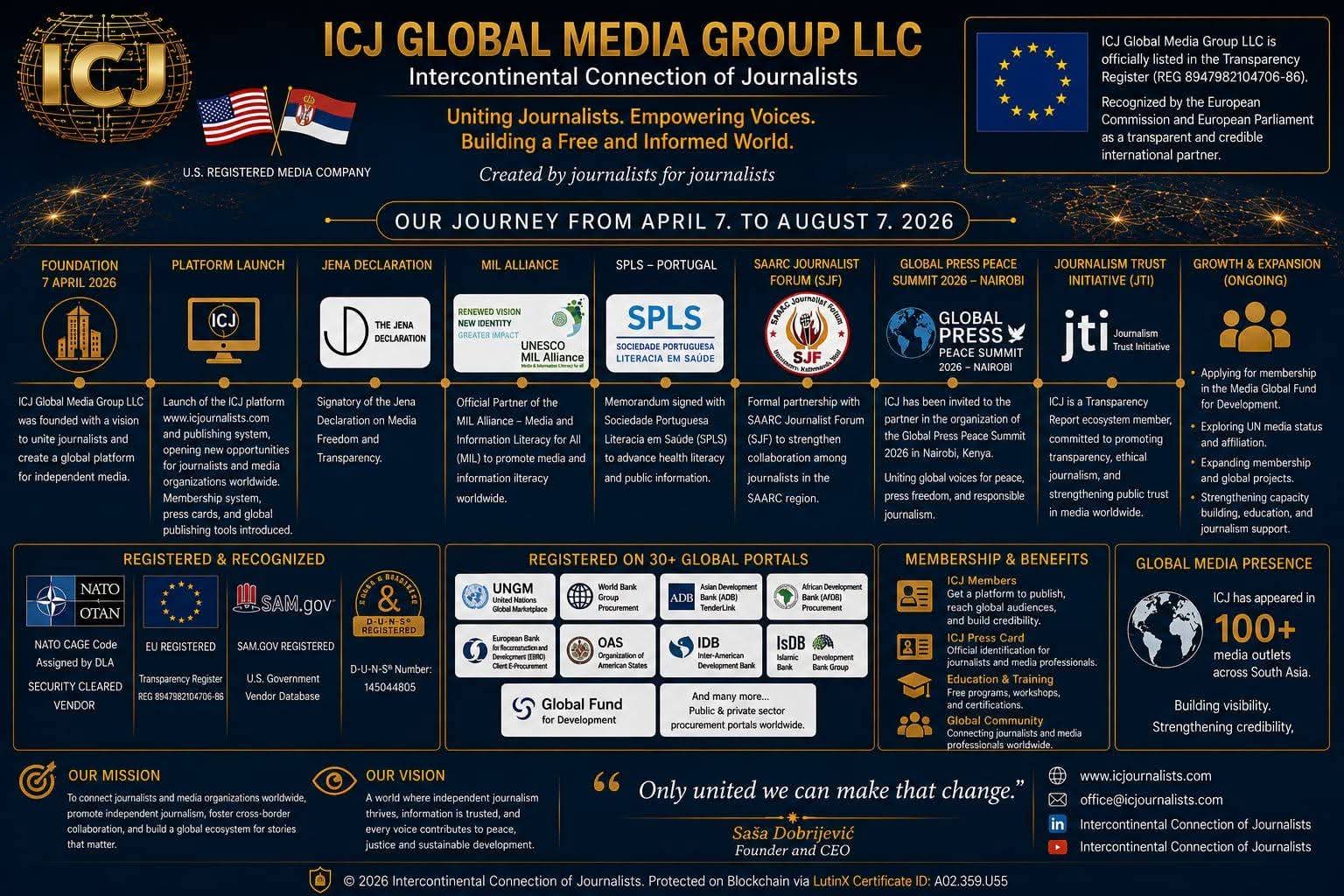 From April 10 to August 20, Lama’s activities in the United States contributed to increasing the visibility of the SAARC Journalist Forum in international media and professional circles.
His participation in UN-related forums, engagement with foreign journalists and international journalism organizations, advocacy for press freedom, and networking with diplomats and international stakeholders provided opportunities to present the priorities of South Asian journalism on a wider international platform.
As International President, Lama emphasized that the challenges facing journalists today are increasingly global and require cooperation beyond national borders.
A Period of International Media Diplomacy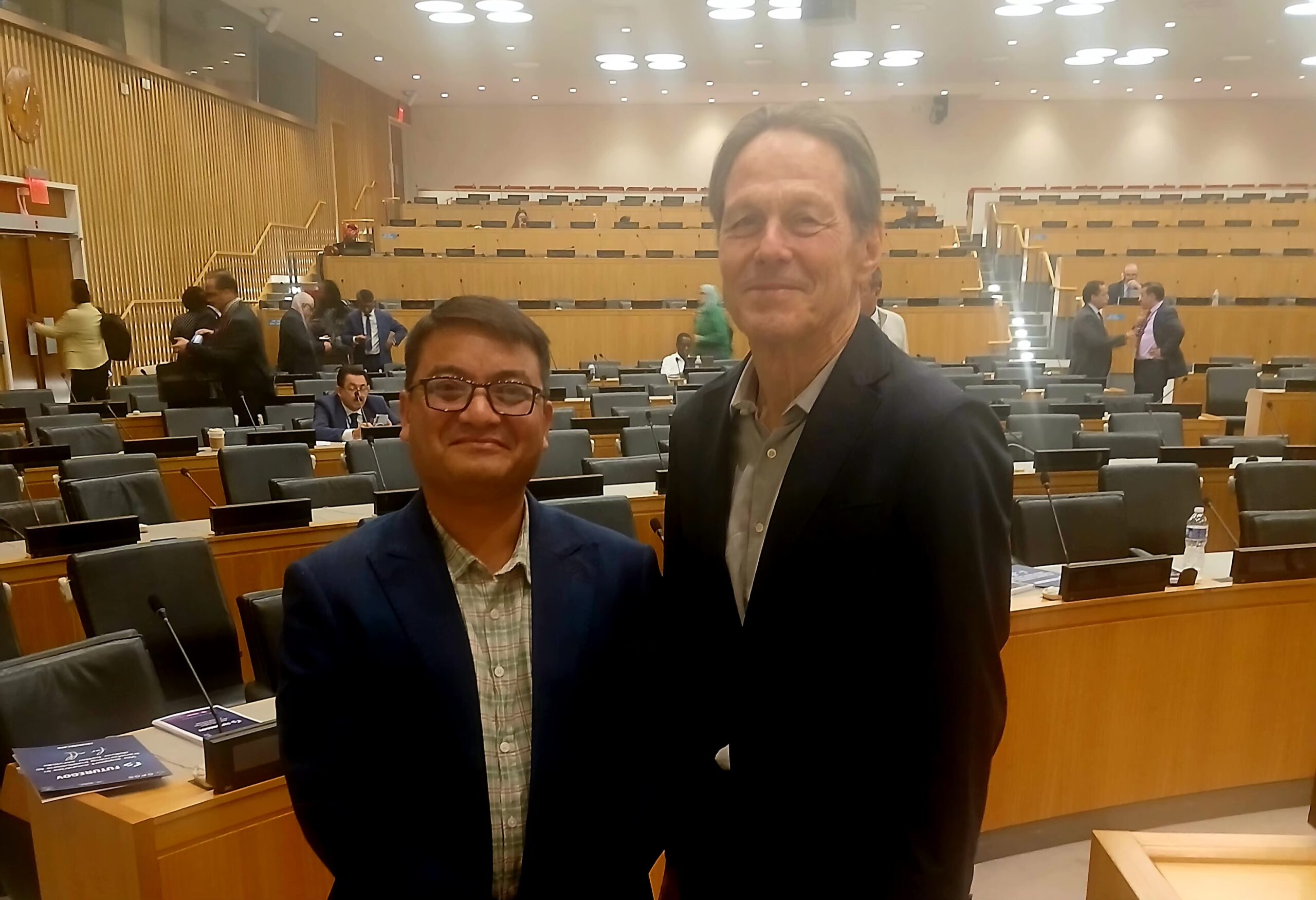 The April–August 2026 period can therefore be described as an important phase of international media diplomacy for Raju Lama and the SAARC Journalist Forum.
From the United Nations in New York to meetings with international journalists and media organizations, Lama worked to connect South Asian journalism with wider international debates on democracy, development, press freedom, governance and global cooperation.
His activities demonstrated SJF’s commitment to strengthening the professional network of South Asian journalists while promoting dialogue and cooperation with journalists and institutions around the world.
Conclusion
Between April 10 and August 20, 2026, SAARC Journalist Forum International President Raju Lama used his professional presence in the United States to promote South Asian journalism, press freedom, journalists’ rights and international media cooperation.
His participation in UN and ECOSOC-related programs, engagement with international journalists and media organizations, advocacy for journalists, and efforts to build international partnerships have helped broaden the international outreach of the SAARC Journalist Forum.
The activities represent an important step toward strengthening South Asia–United States media relations and building a wider Global South journalism network, with SJF positioned as a platform for professional solidarity, dialogue and cooperation among journalists.
Posted: August 20, 2026 by admin_raju Leave a Comment
SAARC Journalist Forum Expresses Solidarity with U.S. Press Freedom Coalition, Urges Congress to Protect Foreign Journalists
Kathmandu, August 20, 2026 — The SAARC Journalist Forum (SJF) has expressed its solidarity with the Society of Professional Journalists (SPJ), the Arab & Middle Eastern Journalists Association, the Committee to Protect Journalists (CPJ), the Foreign Press Association of the USA and other journalism and press-freedom organizations opposing new U.S. Department of Homeland Security (DHS) restrictions affecting foreign journalists.
The coalition is urging the U.S. Congress to block the new DHS rule that would replace the longstanding practice of admitting foreign journalists for the duration of their assignments with fixed admission periods. The rule is scheduled to take effect on September 15, 2026, although its implementation could still be affected by congressional or legal action.
Under the new framework, foreign journalists holding I visas could face a maximum admission period of 240 days, while Chinese journalists would face a shorter initial period of 90 days, according to reporting on the rule and the legal challenge brought against it.
The SAARC Journalist Forum said it stands firmly with the international and U.S.-based journalism organizations that have raised concerns that such restrictions could undermine independent journalism, international press coverage and the free flow of information.
“The SAARC Journalist Forum stands in solidarity with the Society of Professional Journalists and all organizations defending the rights and professional freedom of foreign correspondents. Journalism must not be weakened by policies that make it unnecessarily difficult for journalists to report from the United States,” SJF International President Raju Lama said.
The SJF emphasized that foreign correspondents play an important role in helping audiences around the world understand U.S. politics, society, economy, science, culture and international affairs. Limiting their ability to remain in the country for the duration of legitimate professional assignments could reduce the depth, continuity and diversity of international news coverage.
The coalition statement highlighted concerns that the restrictions could damage the United States’ reputation as a global center for press freedom and could result in less nuanced international understanding of the country and its institutions.
The SJF also welcomed the growing legal and professional response to the new policy. On August 18, a coalition of unions and advocacy organizations filed a federal lawsuit challenging the new visa restrictions, arguing that the changes could seriously harm foreign journalists and other affected nonimmigrant groups.
The SJF called on the U.S. Congress and the DHS to reconsider the restrictions and ensure that legitimate foreign journalists can continue their professional assignments without unnecessary barriers.
The Forum stressed that press freedom is a universal principle and that journalists from South Asia and other regions should be able to report independently and professionally on matters of international importance.
The SAARC Journalist Forum reaffirmed its commitment to working with international journalism organizations to defend journalists’ rights, promote freedom of expression and strengthen cross-border cooperation among media professionals.
Last Updated: August 17, 2026 by admin_raju Leave a Comment
SAARC Journalists from Bangladesh Holds Meeting in Bhutan
Thimphu, Bhutan: A delegation of SAARC Journalist Forum (SJF) from Bangladesh Chapter Sunday called on Rinzin Wangchuk, a Central Executive Member of the SJF. The delegation visited Bhutan at the invitation of Rinzin Wangchuk and held a meeting with the executive committee member at Thimpu.
During the meeting, they exchanged views on various issues centering enhancement of mutual cooperation among saarc journalists from member countrie.
They discussed issues, especially the problems the member countrirs are now facing, and stressed the need for more cooperation from respective governments to overcome the problems and help them to develop skills and discharge their responsibilities efficiently with due honour.
Development training focusing AI (Artificial Intelegance) for SAARC members as well as the importance of fostering peace, democracy, and press freedom across South Asia were also hilighted in the meting.
Since it inception SAARC Journalist Forum through various conferences and seminars urged concerned authorities and the organization to keep members informed of future initiatives for further strengthening of regional collaboration.
Rinzin Wangchuk is the former President of the Journalists Association of Bhutan and former Editor of Kuensel, the country’s leading national newspaper.
Bangladesh delegation arrived in Thimpu, the capital of Bhutan, on August 15 following their participation in a 4-day International Indigenous Journalism Conference held in Kathmandu, Nepal from August 9 to 12.
Led by senior journalist Md. Ziaur Rahman, the delegation included Md. Abdur Rahman — Secretary General, SAARC Journalist Forum & Senior Correspondent, The Bangladesh Post,
Mushtaq Ahmed Mubaraqui — Editor, The Daily Bongobani, Md. Ziaur Rahman — Special Correspondent, The Daily Aajkal, Mohammad Muniruzzaman — Editor, Daily Bank Beema Economics, Panna Zaman — Managing Editor, Daily Amar Bangla, Md. Abu Bakar Siddique — Senior Correspondent, Daily Aajker Provat.
Last Updated: August 15, 2026 by admin_raju Leave a Comment
SAARC Journalist Forum President Raju Lama Extends Greetings on India’s 80th Independence Day
Kathmandu/New Delhi, August 15, 2026 — Raju Lama, International President of the SAARC Journalist Forum (SJF), has extended his warm greetings and best wishes to the Government and people of India on the occasion of the country’s 80th Independence Day.
In his message, Lama praised India’s remarkable journey since independence and acknowledged its significant contributions to democracy, economic development, technological innovation, and regional cooperation in South Asia. He said India’s progress has inspired millions across the region and strengthened the collective aspirations of South Asian nations.
“On behalf of the SAARC Journalist Forum and journalists across South Asia, I extend heartfelt congratulations and best wishes to the people of India on the historic occasion of the 80th Independence Day. This milestone reflects India’s enduring commitment to democracy, diversity, freedom, and development,” Lama stated.
He emphasized the importance of media in safeguarding democratic values and promoting mutual understanding among nations. Lama noted that journalists have a crucial role in fostering peace, combating misinformation, and strengthening people-to-people relations throughout the SAARC region.
The SJF President also highlighted the longstanding cultural, historical, and people-to-people ties among South Asian countries and expressed hope for greater regional cooperation, peace, and prosperity in the years ahead.
He reaffirmed the commitment of the SAARC Journalist Forum to promoting press freedom, human rights, democratic values, and regional harmony.
“May the spirit of freedom, unity, and progress continue to guide India toward greater achievements and contribute to peace and stability in South Asia,” he added.
The SAARC Journalist Forum is an international organization representing journalists from South Asian countries and works to promote press freedom, democracy, human rights, peace journalism, and regional cooperation.
Recent Posts
Recent Comments
Archives
Categories